


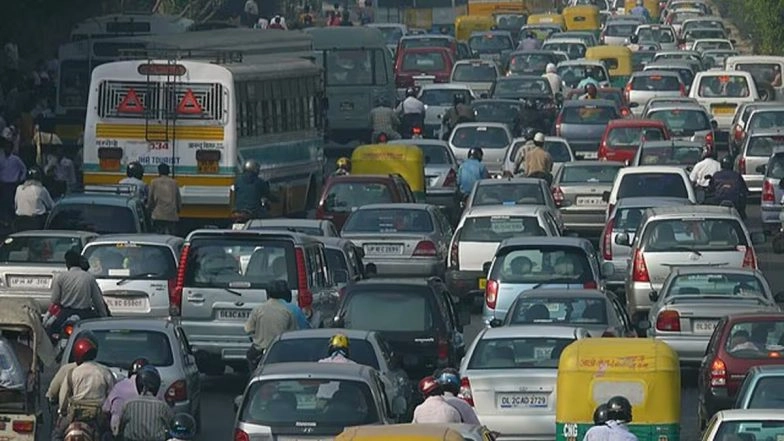
New Delhi, January 9: India is set to take a major leap toward safer and smarter roads as the government prepares to roll out Vehicle-to-Vehicle (V2V) communication technology. The initiative, led by the Ministry of Road Transport and Highways, aims to significantly cut road fatalities by allowing vehicles to exchange safety-critical information in real time.
With India recording over 1.5 lakh road deaths every year, officials believe V2V can act as a digital safety net, warning drivers of potential collisions before they occur. The government has already begun earmarking radio frequency spectrum and is drafting regulatory changes to integrate the technology into the national automotive framework. Union Minister Nitin Gadkari Says Cost of EVs To Match Petrol, Diesel Vehicles in About 2 Years.
What Is Vehicle-to-Vehicle Technology
Vehicle-to-Vehicle (V2V) technology allows cars to communicate directly with each other using short-range wireless signals. Through this system, vehicles continuously share data such as speed, location, direction, and braking status, creating a real-time awareness network on the road. India Surpasses Japan to Become World’s 3rd-Largest Automobile Market, Eyes Top Spot in 5 Years, Says Nitin Gadkari.
Unlike cameras or sensors that depend on visibility, V2V communication can function in fog, heavy rain, or at blind intersections. This capability is particularly relevant for Indian road conditions, where visibility challenges and unpredictable traffic are common.
How This Works
V2V systems operate using Dedicated Short-Range Communication (DSRC) or Cellular Vehicle-to-Everything (C-V2X) modules that transmit data several times per second. If a vehicle ahead brakes suddenly or two vehicles are approaching an intersection on a collision course, the system instantly sends alerts to drivers, giving them crucial extra reaction time.
To support the rollout, the government plans to reserve spectrum in the 5.9 GHz band for Intelligent Transport Systems, ensuring fast and interference-free communication. Amendments to the Central Motor Vehicles Rules will also set uniform technical standards so vehicles from different manufacturers can communicate seamlessly.
Rollout Plan and Cost Impact
The nationwide implementation is expected to follow a phased approach. Initial adoption may begin with commercial vehicles, premium cars, or select smart corridors before becoming mandatory for all new passenger vehicles. The added cost is estimated at INR 5,000 to INR 10,000 per vehicle, with prices likely to fall as adoption scales up.
The Road Ahead
V2V technology is expected to work alongside Vehicle-to-Infrastructure (V2I) systems, enabling traffic signals, toll booths, and road signage to share real-time information with vehicles. As consultations with automakers and technology providers continue, the government has stressed the importance of data privacy and cybersecurity to ensure safe and reliable deployment across India.
(The above story first appeared on LatestLY on Jan 09, 2026 09:01 AM IST. For more news and updates on politics, world, sports, entertainment and lifestyle, log on to our website todaynews24.top).
