


When an airstrike tore through the Donetsk Academic Regional Drama Theater in Mariupol on March 16, 2022, hundreds of people were in and around the building at the time, including civilians seeking shelter from Moscow’s deadly invasion.
There are conflicting reports on how many were killed in the blast, but legal experts say there is overwhelming evidence that the strike constituted a war crime. Investigations based on witness testimony point to a Russian strike on the theatre. Moscow denies destroying it, and instead blames Ukraine.
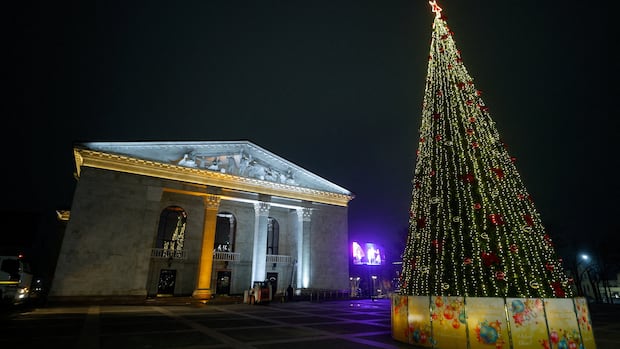
Now, nearly four years later, Russian-appointed officials say the theatre, now under their control, has been rebuilt, modernized and is nearly ready to host audiences of nearly 500.
They are billing it as a careful restoration of a treasured culture site, but Ukrainians who have fled Mariupol are calling it an act of desecration.
“There were so many people in the theatre during the bombing and a lot of people were killed there,” said Ihor Kytrysh, an actor who had been performing at the Mariupol theatre since 2000, and is now living in western Ukraine.
“It’s like performing a play on the bones of the dead.”
Curtains going up
Russian state media reported that the theatre is slated to officially reopen on Dec. 25, and that plays will start being staged there at some point in the new year.
The theatre troupe in Mariupol is currently putting on performances at different venue, and officials say that will continue over the holidays.

Russia has promoted its restoration of the site, saying that hundreds of construction workers were deployed to carefully rebuild the theatre while preserving its historic facade. Occupation authorities have renamed the building the Mariupol Republican Order of the Badge of Honour Russian Drama Theatre. They note on the theatre’s website that it’s being reborn, like the entire city of Mariupol.
In the weeks after Moscow launched its full-scale invasion of Ukraine on Feb. 24, 2022, Russia spent weeks trying to capture the strategic eastern port city.
The theatre strike in March 2022 happened shortly after 10 a.m., with Amnesty International concluding that Russian aircraft likely launched two 500-kilogram bombs at the site.
It’s not clear how many were killed; estimates vary widely. A report by Human Rights Watch suggests at least 15 died in the blast, while an investigation by the Associated Press puts the number closer to 600.
Two weeks after the airstrike, Russian forces had moved into the centre of the city.
A new start
One day before the blast, Kytrysh and his family fled to Berdyansk, another port city about 65 kilometres to the west.
He and his partner, fellow actor Olena Bila, have now relocated along with some staff to Uzhhorod, a city in the far west of Ukraine, on the border with Slovakia.
They have been staging plays, travelling across the country and at times even internationally with their production, called Mariupol Drama. It recounts the stories of those who survived the bombing, and the enduring sense of loss suffered by those who had to flee their hometown.

Kytrysh, whose Mariupol apartment was destroyed in the siege, told CBC News the theatre should never be reopened, but rather replaced with a monument to the victims.
He said he is no longer in touch with anyone still in Mariupol, but says some of the theatre’s actors and administrators decided to stay behind in the city, despite Russia’s occupation.
CBC News has reached out to the team currently running the theatre, but has received no response.
A theatre rebuilt and ‘reborn’
A section detailing the theatre troupe’s history on the theatre’s website states that a previous building was destroyed during the Second World War, and that in 1960, a new building was ceremoniously opened.
The “events of 2022 have been a difficult test for the city and the theatre,” the post states. However, it says, the great Russian and Soviet classics by the likes of Alexander Pushkin and Anton Chekhov have been returned to the stage.
In an interview with the Moscow-based news site Moskovsky Komsomolet, Igor Solonin, the theatre’s Russian-appointed cultural director, was asked to comment on criticism from Ukrainians on reopening the theatre.

He dismissed those concerns, saying most cities across Europe have seen military action in the past.
“Aren’t Berlin, Paris and Warsaw built on someone else’s bones?” Solonin told the publication, in an interview published Nov. 25.
In a separate interview with Russia’s TASS news agency, Solonin said a gala would be held on Dec. 25, which would include a special thanks to the architects and engineers from St. Petersburg who helped oversee the reconstruction.
‘Absolutely wrong’
Former Mariupol resident Serhii Kesarev was staying in a school about 100 metres away from the theatre the day it was destroyed. Before the war, he said the building and the square in front of it were the heart of the city. He described it as Mariupol’s calling card.
In the weeks following the bombing, after Russia captured the city centre, he said he went to the theatre a few times because it became a site where water was being distributed.
He said over a two-week period, he counted eight different bodies lying on the road that no one was retrieving.

Kesarev, his wife and their then-11-year-old son left the city of Mariupol on April 19, 2022 and are now living in Kyiv.
“If I were in Mariupol now, I would 100 per cent not go to the [new theatre],” he told CBC News via WhatsApp.
“After such a tragedy, holding celebrations there, dancing and applauding is simply too much. Absolutely wrong.”
