

New Images Of Nasa Interstellar Comet 3I/ATLAS 3 Emerge As It Sets To Make Historic Closest Approach To Earth | Science & Environment News

Interstellar comet 3I/ATLAS only the third known visitor from outside our solar system continues to fascinate astronomers worldwide. First detected on July 1, 2025, by the ATLAS survey telescope in Chile, the comet instantly became a global sensation as space agencies rushed to collect as much data as possible.
Harvard scientist Avi Loeb stirred debate by suggesting that the object may not be entirely natural and could even represent some form of “alien technology,” citing various anomalies in its behavior. However, NASA officially classifies 3I/ATLAS as a comet, as reflected in the latest images it released.
As the comet moves closer toward its December 19, 2025, nearest approach to Earth, several observatories have captured new images.
Add Zee News as a Preferred Source
Here’s a look at the latest three:-
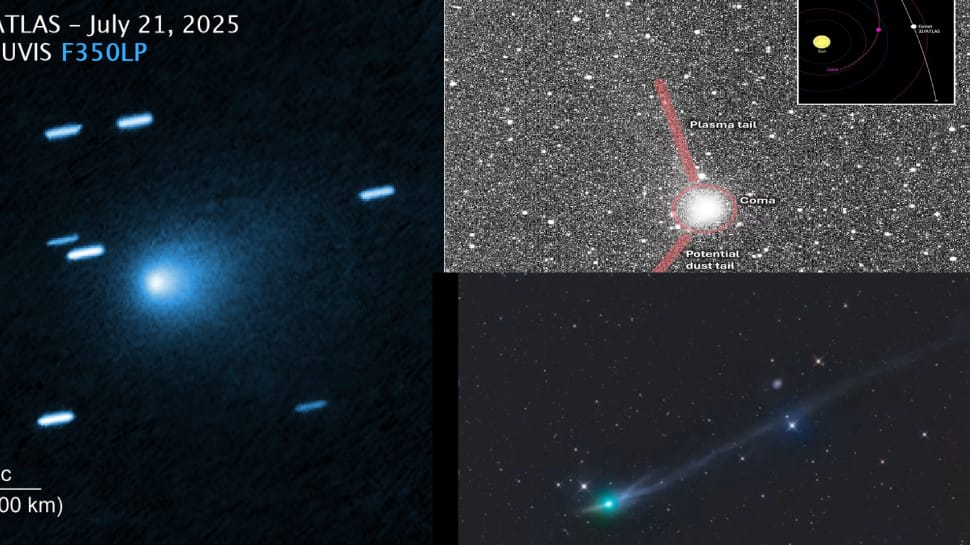
1. NASA’s Hubble Space Telescope: A Clear View of the Nucleus
Hubble was among the first to image 3I/ATLAS shortly after its discovery, showing a teardrop-shaped dust cocoon around the object. On November 30, Hubble reobserved the comet using its Wide Field Camera 3, when it was 286 million kilometers away.
The new image shows background stars stretched into streaks, as Hubble tracked the comet’s rapid motion. At the center is a bright white dot, representing the comet’s nucleus, surrounded by a glowing coma and a visible tail.
According to Loeb’s analysis, the coma now extends roughly 40,000 km, while the anti-tail reaches nearly 60,000 km. NASA has not yet released the full data set from this observation, which will be crucial for determining the composition of the gas plume.
2. ESA’s Juice Spacecraft: Dual Tails Detected
On December 4, the European Space Agency (ESA) shared a new image captured by its Jupiter Icy Moons Explorer (Juice) spacecraft using its Navigation Camera (NavCam).
Taken on November 2, just two days before Juice’s closest approach at 66 million km, the photo reveals the comet’s glowing coma and hints of two tails.
The plasma tail—made of electrically charged gas—extends toward the top of the frame.
A fainter dust tail, composed of tiny solid particles, stretches toward the lower left.
ESA noted that full data results will be available in February next year, as the spacecraft is currently using its main antenna as a heat shield, limiting data transmission speed.
3. Stunning Amateur Image from Namibia
A breathtaking ground-based image of 3I/ATLAS was taken on December 2, 2025, by amateur astronomers Gerald Rhemann and Michael Jäger in Farm Tivoli, Namibia. Using a 12-inch telescope, they combined exposures of 20, 6, 6, and 6 minutes to reveal fine details of the comet.
Loeb explained that the image’s field of view—75 by 110 arcminutes—corresponds to 6.1 by 9 million kilometers at the comet’s distance of 280 million kilometers from Earth on that day.
With its closest approach just days away, 3I/ATLAS continues to deliver extraordinary data and visuals. As more observations come in, scientists hope to unlock even more clues about this rare interstellar visitor—and whether it behaves like a typical comet or something entirely different.
