


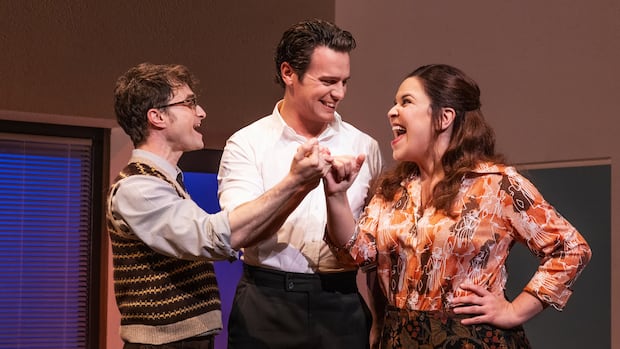
If you were looking for the Broadway musical least likely to find wide theatrical success among general audiences … well, that would probably be Cats.
But if you were looking for the second least-likely Broadway musical to find wide theatrical success among general audiences … OK, that would be Dear Evan Hansen.
But let’s say you were to go a bit further down the list. Eventually, you’d bump into Merrily We Roll Along: the once-panned, then triumphantly revived Tony-winner — now recorded and released as a professionally-shot stage production.
Somehow making its way into theatres this week, the almost standoffishly sentimental Stephen Sondheim musical is not as narratively or sonically soothing as Wicked or Cynthia Erivo’s Defying Gravity riff. Instead, what you get is musical theatre at its musical theatry-est, featuring tracks so full of jazzy sharps and flats that one character even ironically mocks them in song.
“There’s not a tune you can hum,” croons the dollars-and-cents obsessed producer Joe Josephson, played by Reg Rogers. “There’s not a tune you go: ‘Bum-bum-bum-di-dum.'”
WATCH | Merrily We Roll Along trailer:
And that’s not even mentioning a story so convoluted and depressing, its original 1981 run inspired mass walkouts and a closure barely two weeks after its debut.
Based on the George S. Kaufman and Moss Hart play of the same name, it’s a story of a three-way friendship, told in reverse chronological order and peppered with stilted-but-elevated turns of phrase like “Don’t let’s go to extremes,” “Fermez all those bouches” and “The worst vice in this world is advice.”
This is a musical so scattered and uninterested in commercial viability that it makes scathing criticism of fun, accessible art one of its central themes. A show that spoils its own ending right in the opening number, and then demands its audience tag along for the following two hours to see why it all matters.
In short, it’s fantastic.
To be clear, Merrily We Roll Along is not the production to win over your showtune-hating friend. Opening on a disastrously climactic party in 1976, we’re introduced to Merrily’s main characters right as they decide to part ways for good.
First, there’s Franklin Shepard (Jonathan Groff), a composer simultaneously at the apex of his career and the bottom of his personal life. Having just effectively sold his soul to get a banal, though lucrative Hollywood film released, we look on as his drama critic best friend Mary (Lindsay Mendez) drinks herself into a stupor, before storming out of Shepard’s self-indulgent, self-pitying whirlpool of a life.
We then slowly journey a few years at a time back to the night they met in 1957. Witnessing adultery, betrayal, divorce courts and a whole lot of musical theatre, we learn just what drove apart Mary, Franklin and their lyricist/playwright friend Charley (Daniel Radcliffe).
The closer to the beginning we find ourselves, the more optimistic our characters become.
As these starry-eyed kids take different paths to different ends — selling out for success, toiling toward genius in relative poverty, or simply giving up — the play takes on an increasingly tragic framing as the songs get more upbeat.
Trapped by their own ambition and blind to the gradual accumulation of emotional wounds they inflict on one another, Merrily We Roll Along hammers its point home with an unrelenting, heartbreaking finality: Be careful what you wish for, but be more careful of what you give up to get it.
Total failure, to total success
While that sentiment was there from the get-go, it’s taken decades of rewrites and revivals to have it come across effectively. Along with substantive rewrites and songs cut during that original run, the original conceit of having the main characters played by teenagers was mostly abandoned in later restagings.
It still wasn’t enough to save Merrily. The musical’s abysmal failure was charted in the equally interesting documentary Best Worst Thing That Ever Could Have Happened.
What ended up saving it was a superfan: actor and director Maria Friedman, who turned a role in a 1992 production of the play into a series of restagings.
Friedman’s guiding hand, along with the star-power of Groff and Radcliffe, eventually catapulted it to stunning heights — including four Tonys and a 2023-2024 run that saw ticket prices balloon to nearly $1,000 a pop — that likely helped inspire the coming Richard Linklater adaptation, filmed over the span of 20 years as his actors age.
Much of what drew those audiences is visible here. If you are aware of this musical, it’s likely because of the electric, mildly viral Franklin Shepard, Inc. song, performed by Radcliffe.
In this movie version, Radcliffe leans even further into the festering, resentful rage subtly apparent under the surface of a story posturing as a buddy film.
WATCH | Daniel Radcliffe performs Franklin Shepard, Inc.:
Pro-shot paradise
This is further supported by what is thankfully becoming less of a rarity in the musical theatre world: a “pro-shot” — a professionally recorded version of a stage play — that is both widely available, and takes itself seriously as a distinct format.
Though nearly all Broadway musicals are recorded for posterity, vanishingly few of them ever make their way into the public’s hands. The expenses associated with filming, editing and managing the rights for distribution usually makes pro-shots a nonstarter.
This has long been the bane of musical theatre fans’ existence. Broadway is restrictive both in terms of location and cost, meaning that most fans know their favourite shows — and, more importantly, their favourite casts — will end their run long before they ever get a chance to see it.
Luckily, the stunning box office success of Hamilton‘s pro-shoot helped prove audiences are actually willing to shell out for movie tickets. And that’s not the only one. In his other smash revival success, Groff’s restaging of the musical Falsettos sold out theatres when its pro-shot went live in 2017.
Somewhat differently here, though, is the fastidious approach Friedman has taken to shooting this musical.
Combining three live shows with audience-free tapings, Merrily straddles the line between stage and film production. Friedman carefully guides our eyes with closeups that omit much of the action outside of the frame. The camera moves with the actors, and only occasionally allows the applause or reaction of the audience to bleed through.
It’s a subtle break from most other pro-shots, which do more to maintain the expansive experience of being in the theatre. While this does run the risk of removing some of the magic, the raw emotionality delivered here more than makes up for it.
In both the opening and closing of this Merrily, we are treated to an extreme closeup of Franklin, allowing us to see him deliver the subtleties of expression usually impossible to pick up in a live performance.
We see all the hope and tragedy play out in the lines on his face, as we hear but don’t see adoring fans — and decidedly less adoring friends — sing about the intractable march of time, and the foolishness of dreams.
It might not be the real Broadway experience, but does it ever come close.
