

Interstellar Comet 3I-ATLAS Making Its Closest Approach To Earth This December? Check Latest Updates | Science & Environment News

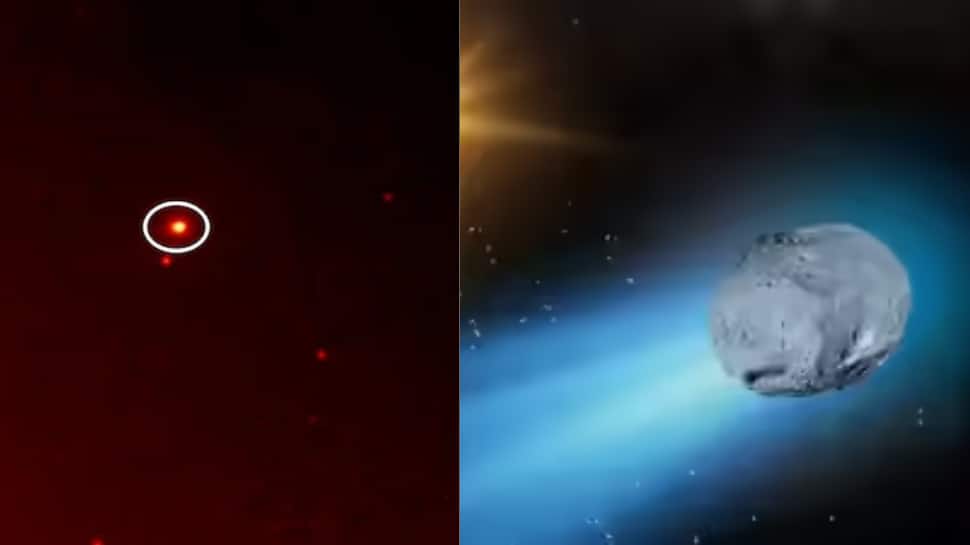
The highly anticipated moment for skywatchers is finally approaching as interstellar comet 3I/ATLAS prepares for its closest pass by Earth this December. The mysterious object famous for both scientific intrigue and viral conspiracy theories will soon reach the nearest point it will ever come to our planet, offering astronomers a rare chance to study a visitor from another star system.
Whether you’re a seasoned astronomer or simply fascinated by the hype surrounding this cosmic traveller, here’s a complete look at what 3I/ATLAS is, where it came from, and how you may be able to witness its journey.
What Is 3I/ATLAS?
Add Zee News as a Preferred Source
3I/ATLAS gained global attention in July 2025, when astronomers confirmed it as only the third known interstellar object to pass through our solar system. According to NASA, it was traveling at an astonishing 137,000 mph when first detected.
Its extreme speed and hyperbolic trajectory proved that 3I/ATLAS formed around another star before being pushed into interstellar space, where it may have drifted for billions of years. Originating roughly from the direction of the Sagittarius constellation near the Milky Way’s center, the comet has only recently entered our cosmic neighborhood.
Unlike typical comets bound to the Sun’s gravity, 3I/ATLAS is not tied to our solar system and will eventually head back into deep space.
How Big Is the Comet?
Astronomers are still refining size estimates, but the European Space Agency (ESA) suggests that 3I/ATLAS could span anywhere from a few hundred feet to several miles.
Data from the Hubble Space Telescope indicates its icy nucleus could measure between 1,400 feet and 3.5 miles across.
Where Is 3I/ATLAS Right Now?
The comet is steadily moving toward its historic moment: a close approach to Earth on December 19, coming within about 170 million miles of our planet. Although this is still a vast distance, it will be the closest 3I/ATLAS will ever come before permanently leaving our solar system.
Earlier, on October 30, it passed within 130 million miles of the Sun, just inside Mars’ orbit. Despite rising curiosity, scientists emphasize that 3I/ATLAS poses no threat to Earth.
Can You See 3I/ATLAS From Earth?
While 3I/ATLAS is not visible to the naked eye, even a small telescope can capture it in the pre-dawn sky through spring 2026, NASA says.
You can also track its real-time movement using NASA’s interactive tool, “Eyes on the Solar System.”
3I/ATLAS’s Closest Approach to Earth on December 19, 2025
The interstellar comet is now heading toward its closest-ever encounter with Earth, taking place on December 19, 2025. According to ESA, 3I/ATLAS will pass safely at a distance of 1.8 AU—about 270 million kilometers, or 1.8 times the distance between Earth and the Sun.
Scientists stress that there is no danger whatsoever associated with this flyby. In fact, during its closest approach, the comet will be located on the opposite side of the Sun from Earth, creating an even greater buffer.
ESA explains: “The closest the comet will come to Earth is about 270 million km – about 1.8 times the distance between Earth and the Sun. During its closest approach, it will actually be on the other side of the Sun. It poses no danger to our planet or any other planets in the Solar System.”
How to Watch 3I/ATLAS on December 19
Although 3I/ATLAS will remain far from Earth, December 19 will offer one of the best observational opportunities. With a small telescope, observers may spot the comet faintly glowing in the pre-dawn sky—this is the closest and clearest view we will ever get before it heads back into interstellar space.
For astronomy enthusiasts, it’s a rare opportunity to witness a true cosmic interloper on its brief passage through our solar system.
NASA Releases New Images of 3I/ATLAS
On November 19, NASA released a set of high-resolution images taken by its telescopes and spacecraft. These new photos reveal previously unseen details of the comet’s glowing tail, dust features, and evolving structure.
NASA’s complete archive of 3I/ATLAS imagery, along with expert commentary, is available in the agency’s visual collection.
Is 3I/ATLAS an Alien Ship? NASA Denies Conspiracy Claims
The comet’s unusual path and interstellar origin have sparked several conspiracy theories. One widely circulated idea—suggested by Harvard astrophysicist Avi Loeb—proposes that 3I/ATLAS could be alien technology. Although Loeb later clarified that the object is “most likely a natural comet,” he has not fully dismissed other possibilities.
NASA, however, has firmly rejected such claims.
In a viral social media exchange with Kim Kardashian, NASA Acting Administrator Sean Duffy said:
“No aliens. No threat to life here on Earth.”
Similarly, Nicola Fox, head of NASA’s Science Mission Directorate, confirmed that no technosignatures or unusual signals have been detected—reinforcing that 3I/ATLAS is simply a normal comet from another star system.
As 3I/ATLAS makes its historic journey past Earth this December, it offers scientists and skywatchers a rare chance to witness an interstellar visitor up close. While its distant flyby poses absolutely no danger, the event marks a remarkable moment in space exploration and public curiosity. Whether viewed through a telescope or followed online, the comet’s passage is a reminder of how vast—and full of surprises—our universe truly is. And once it moves beyond our reach, 3I/ATLAS will continue its silent voyage back into the depths of interstellar space, leaving behind new data, unforgettable images, and a sense of wonder for those who watched it pass.
