

Ikkis Movie Review: Courage, Sacrifice And Soul – Dharmendra, Jaideep Ahlawat And Agastya Nanda Shine | Movies News

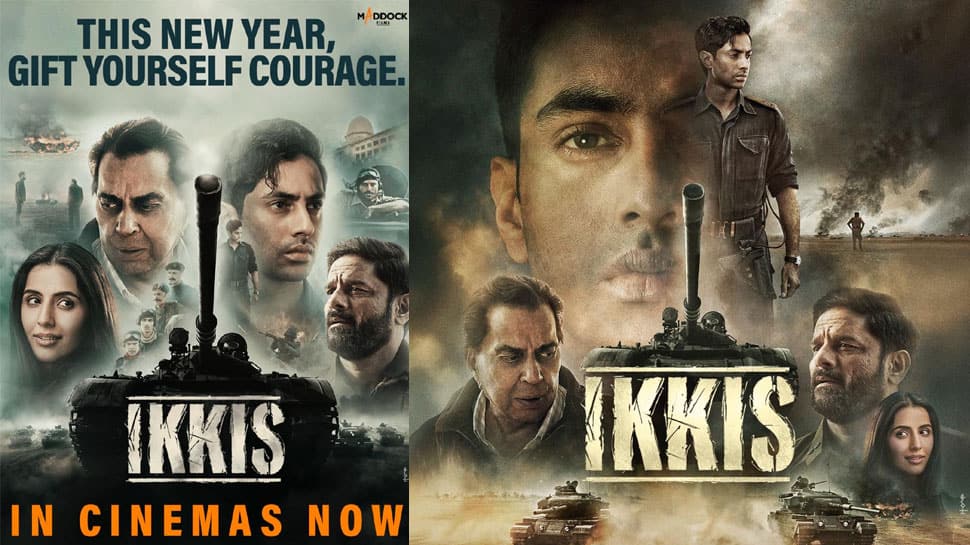
Director – Sriram Raghavan
Cast – Agastya Nanda, Dharmendra, Jaideep Ahlawat, Simar Bhatia
Duration – 143 Minutes
Add Zee News as a Preferred Source

Rating – 4 Stars
Writer- Sriram Raghavan, Arijit Biswas, Pooja Ladha Surti
Veteran filmmaker Sriram Raghavan takes a heroic story and narrate with a lot of sensitivity and humanity, without making any propaganda, the film is about courage, emotions and turmoil of war, which leaves lasting mark on everyone’s life. Though it’s a biographical war drama but its rooted in emotion rather than loud noises, it tells the story of Second Lieutenant Arun Khetarpal, India’s youngest Param Vir Chakra recipient, without resorting to familiar tropes. The film unfolds with grace and dignity and maintains the human element throughout the film.
The filmmaker intentionally opts for two timelines narrative to make it impactful and strengthen the narrative and it works. The first timeline introduces us to Battle of Basantar which took place in December 1971, a young and fearless 21-year-old Arun Khetarpal leads his tank regiment through dangerous, heavily mined terrain. He is brave, charming and infinitely full of heart, his young and innocent energy is just heart-warming to witness on big screen.
War is scary and chaotic business, but makers have opted for different approach, rather than making overindulgent, war sequences are kept tense and immersive. Raghavan avoids jingoism for sake of it, he focuses on the psychological pressure faced by a young officer witnessing a war for the first time.
Actor Agastya Nanda who plays the role of Arun Khetarpal, bring sincerity and dignity of his role. He plays this young, confident and idealistic army officer, who is brave enough to lead the charge but reckless enough to disobey a direct order, which only establishes his character’s age and temperament. He is not our typical reel-hero, he is as real as anything we have ever seen before on big-screen. His courage reveals itself gradually, through action and instinct rather than dialogue or background score.
One of the film’s most powerful moments is Arun’s refusal to abandon his burning tank despite repeated orders to retreat. The scene doesn’t play out as cinematic heroism but as something inevitable, rooted in the values that define him. Nanda’s performance carries a raw edge that makes the sacrifice feel personal rather than symbolic.
And now the second timeline, which is more mature and emotionally driven, set on 2001, and this forms the emotional backbone of the entire film.
Dharmendra steps into the role of Brigadier M L Khetarpal, a father still living with the weight of his son’s sacrifice decades later. He meets another war-veteran Brigadier Khwaja Mohammad Nasir, portrayed with calm authority by Jaideep Ahlawat, changes the dynamics of the film, the narrative of the film turns quieter, more meaningful and reflective – the scars of war. And thankfully this part is not about history or political scores, it’s about memory, pain of losing someone, about people who are left behind to pick-up the pieces and make some meaning out of life. Two war hardened brigadiers, looking back at what it took from them.
Seasoned actor Jaideep Ahlawat delivers his best performance, he is restraint yet charged with emotions, he is controlled yet one could easily make out his aching pain. His character is contemplative, measured, and deeply aware of war’s long shadow. The scenes he shares with Dharmendra are among the film’s finest, built on silences, shared glances, and unspoken understanding. Their walk-through old joints, familiar spaces and eventual visit to the battlefield bring the film to its emotional high point.
Dharmendra, unfortunately his last screen role, deliver a devastatingly surreal performance. His physicality and demeanor don’t require dialogues, his eyes communicate the pride, grief, and unresolved sorrow. His presence just radiates the screen. His scenes opposite Ahlawat feel sincere and earned, standing out as some of the most moving moments in recent Indian cinema.
Visually, Ikkis opts for realism over grandeur. The VFX work is subtle and effective, particularly during the tank warfare sequences, which feel heavy, claustrophobic, and dangerous. Nothing feels exaggerated. Every explosion and maneuver serves the story, keeping the focus firmly on the soldiers rather than the spectacle.
The film’s music and background score follow the same restrained philosophy. The score never overwhelms a scene, instead quietly supporting moments of tension and reflection. In battle sequences, the natural sounds of war take precedence. In the 2001 timeline, the music becomes sparse and introspective. The dialogue, too, is economical and purposeful—lines resonate because they are honest, not because they are dramatic.
Raghavan’s direction is confident and assured. He allows silence to carry meaning and trusts the audience to engage without constant explanation. The screenplay, co-written with Arijit Biswas and Pooja Ladha Surti, is tightly woven, smoothly balancing two timelines without losing emotional clarity. Each scene serves a purpose. Simar Bhatia, as Kiran, Arun’s love interest, leaves a strong impression despite limited screen time. Her character offers a glimpse of the life Arun might have lived, adding emotional texture without distracting from the central narrative.
From a production standpoint, Ikkis signals Maddock Films’ growing commitment to content-driven cinema. Known for experimenting with genres, the studio takes a measured risk here by backing a film that prioritizes emotional truth over formula. The care taken with historical detail and storytelling reflects a project made with intention rather than calculation.
At its heart, Ikkis is a film about what remains after the battle ends. It speaks of love, duty, loss, and belonging—emotions that transcend borders and uniforms. By choosing empathy over anger and memory over messaging, the film achieves something rare. It honours sacrifice without glorifying violence and respects history without turning it into propaganda.
