


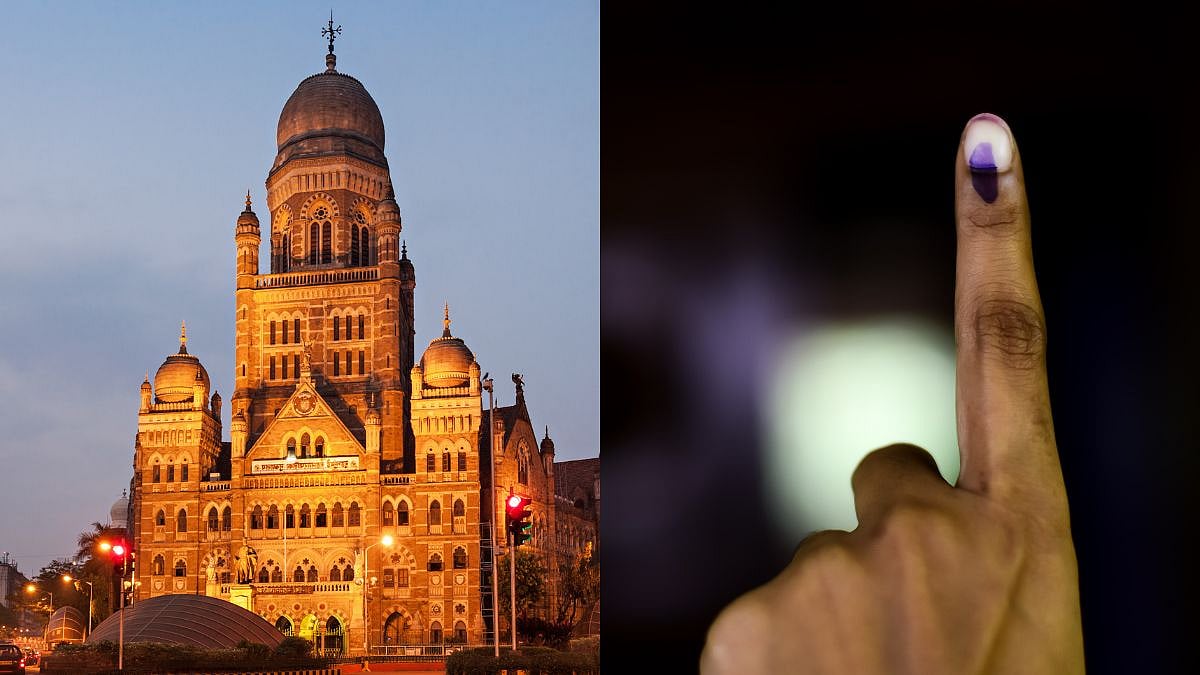
Mumbai heads into the BMC elections after four years without an elected civic body, raising questions on governance, accountability and urban development | Representational Image
Mumbai stepped into the new year with its municipal election finally on the calendar. It has taken four years since the dissolution of the last general body and no representation of the people in the Brihanmumbai Municipal Corporation (BMC).
The governance and the affairs of the city did not cease, of course, but continued without people’s participation. The last election was in February 2017, which, one could argue, seems like another era in the city’s arc.
Budgets soar in absence of elected representatives
For context in monetary terms, the BMC’s annual budget that year was Rs 25,141 crore; the budget for the financial year 2022-23, when the term of the elected general body ended, had nearly doubled to about Rs 46,000 crore. Since then, when the BMC has been controlled or managed, to use a kinder word, by the state government, the annual budget has soared.
The last one, in February 2025, was a staggering Rs 74,427 crore. The astronomical rise tells its own story. Not having an elected general body in India’s richest municipal corporation did benefit a few in the political economy of Mumbai.
Declining liveability fuels debate
There can be debates—and a few conspiracy theories too—because the last four to five years have also seen an enormous slide in the liveability of the city. Every parameter turns in worse figures—from critical ones like road work, land use, destruction of natural ecology, air pollution, public hospitals, and garbage collection to relatively less significant issues like urban design and aesthetics, public lighting, ranking on international indices, and so on. Mumbai ranks way down on liveability, happiness, affordability, and literally everything that a booming metropolis must assure its residents.
Does having a corporator make a difference?
Will having your own representative in the BMC general body matter? Will it change the status quo? Yes and no. This is not a cop-out answer but a layered examination of why our votes in the BMC election still hold enormous significance at one level but are quite meaningless at another. Stay with me here.
Disconnect between citizens and local politics
To be sure, most middle and upper classes have only a faint idea, if at all, of the identity of their elected corporator and how to approach her/him to get civic work done. It is entirely possible that, spending life in gated complexes both at work and at home that are insulated from the city ‘outside’, they have little reason to engage with those who do not talk, speak or work in ‘clean’, white-collared jobs as they do. Yet, it is this disengagement from the local community and politics—isolating themselves into islands of prosperity amidst the chaos, as it were—that has arguably led to a degeneration of the idea of political representation itself.
Role of corporators in participatory governance
To have a representative corporator in the BMC general body and engage with whosoever gets elected, even if it’s not the candidate you voted for, means we the people have a chance to examine the BMC administration up close, question its decisions, seek answers to questions and deadlines for work, place demands, and seed local agendas for approval and ideas for discussion. Basically, through the corporator, if she/he is the cooperative sort, participate in the governance of the city. And, of course, have our little neighbourhood complaints resolved in the shortest possible time.
Limits of the BMC’s authority
Yet, there’s a catch. All the 227 elected corporators in the BMC, even if they rise above inter-party battles, can hardly determine the trajectory of development, or redevelopment, of Mumbai. That municipal command to deliberate upon and decide the direction of development—who does it benefit; what does it bring to the city; what is the ecological cost; what are compensatory steps; and what should the city be—is out of the ken of the BMC. It has been so for at least 25 years.
Decision-making shifted to autonomous bodies
In fact, not only the authority to take decisions but also the planning about major, cost-intensive, city-changing projects has been seized by autonomous authorities and entities who hold enormous powers, work fairly independently of the BMC (even look down upon it as a ‘sanitation and water’ body), and report directly to or take instructions from the top brass in Mantralaya. They have no elected representation within, they are not directly accountable to the people of Mumbai, and they are protected by their political masters in the government.
Rise of SPVs and reduced public accountability
Whether it is the MMRDA, the MSRDC, the MHADA or any other body, this would hold true. These authorities, if persisted with, would at least offer a hearing to delegations of people or activists raising critical issues.
Now, increasingly, there has been the ‘SPVisation’ of city-making and urban governance—a public authority or autonomous entity forms a Special Purpose Vehicle (SPV), often with a small or minority share, with private partners and their faith in the commitment to public good.
This turns it into a facilitator for the private sector with little command or say in the work itself. The Dharavi redevelopment is a classic example; it is relevant here also because 60-65 per cent of the land there belongs to the BMC, but the civic body is not even a backseat driver.
Why voting still matters
In the larger scheme of things, such as how Mumbai’s development should be, what parts should be protected—the Sanjay Gandhi National Park’s eco-sensitive zone, the mangroves between Versova and Bhayander, and the salt pans on its eastern side, to name just three—and what its climate-informed comprehensive plan should be for the next 20 years so that millions can afford a home, commute safely and comfortably, and have open green spaces around them, the BMC election might seem pointless, but the right kind of corporator can make some difference.
Vote, then monitor
In any case, we still need good roads, walkable pavements, and a clean and healthy city, for which we must have corporators in that august hall. Do they work? Only if we keep them on their toes. So, vote and then monitor the elected. There’s hope.
Smruti Koppikar, an award-winning senior journalist and urban chronicler, writes extensively on cities, development, gender, and the media. She is the Founder Editor of the award-winning online journal ‘Question of Cities’ and can be reached at smruti@questionofcities.org
