

‘Big Leap’: Union Minister Ashwini Vaishnaw Announces 1st Telecom System Using India-Made Chips Gets TEC Certification

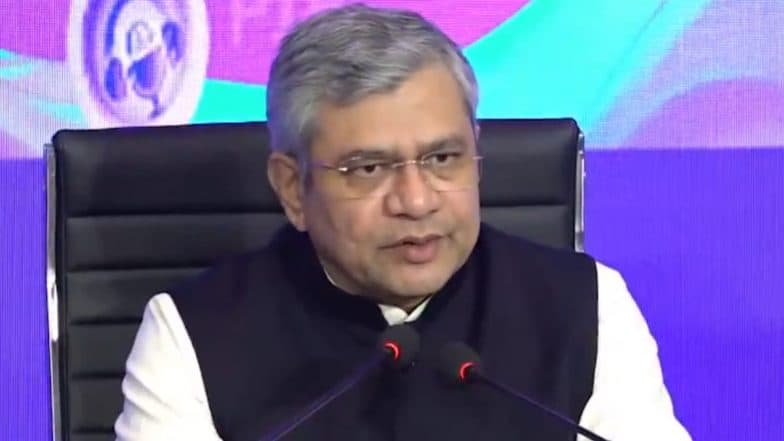
New Delhi, September 6: Union Electronics and IT Minister Ashwini Vaishnaw has announced that a telecom system using only domestically-produced chips has received certification from the Telecommunication Engineering Centre (TEC). The minister praised the development on X social media platform, describing it as a “big leap” for the country’s semiconductor industry.
The minister wrote on X, “Big leap for India’s semiconductor story! In a first, a telecom system running on ‘made in India’ chips has cleared the standards & quality tests (TEC certification).” TEC certification is the Department of Telecommunications’ quality benchmark, ensuring telecom equipment meets strict performance and safety standards. Along with the nod for domestic rollout, the approval has positioned India’s local chips alongside global counterparts, opening export opportunities. Is There Sunday Mega Block on September 7, 2025? Will Mumbai Local Train Services Be Affected on Central, Western and Harbour Lines? All You Need To Know.
Ashwini Vaishnaw Calls ‘Big Leap’ as India-Made Telecom System Gets TEC Certification
Big leap for India’s semiconductor story!
In a first, a telecom system running on ‘made in India’ chips has cleared the standards & quality tests (TEC certification). 🇮🇳 pic.twitter.com/tFQLF04Ool
— Ashwini Vaishnaw (@AshwiniVaishnaw) September 5, 2025
The milestone indicates progress in reducing reliance on imported semiconductors, a vulnerability highlighted by recent global shortages. Analysts say India’s strategy of enhancing capacity in design, assembly, testing, and integration allows it to address supply chain gaps.
As Taiwan, South Korea, Japan, China, and the US dominate chip production, their concentration creates supply chain risks, which India seeks to mitigate. Semiconductor equipment manufacturer ASML Holding NV, a global leader in semiconductor lithography, has recently announced its intention to strengthen its partnership with Indian businesses in the upcoming year.
The India Semiconductor Mission (ISM) was launched in 2021 with a Production Linked Incentive (PLI) scheme worth Rs 76,000 crore to boost domestic manufacturing and design in the semiconductor sector. Approved projects under this scheme total 1.60 lakh crore, including Tata Electronics’ 91,000 crore fab in Dholera, Micron’s 22,516 crore packaging facility in Sanand, and CG Power’s new OSAT pilot line that started operations in August. Madhya Pradesh: Police Investigating ‘Objectionable Songs’ During Eid-E-Milad-Un-Nabi Procession in Khandwa.
India is focusing on mature nodes in the 28nm–65nm range, essential for telecom, automotive, and industrial applications. India’s semiconductor market stood at $38 billion in 2023 and is expected to hit $45 to $50 billion in 2024–25 and $100 to $110 billion by 2030. Globally, the semiconductor market is projected to grow to $1 trillion by the same year.
(The above story first appeared on LatestLY on Sep 06, 2025 11:24 AM IST. For more news and updates on politics, world, sports, entertainment and lifestyle, log on to our website todaynews24.top).
