


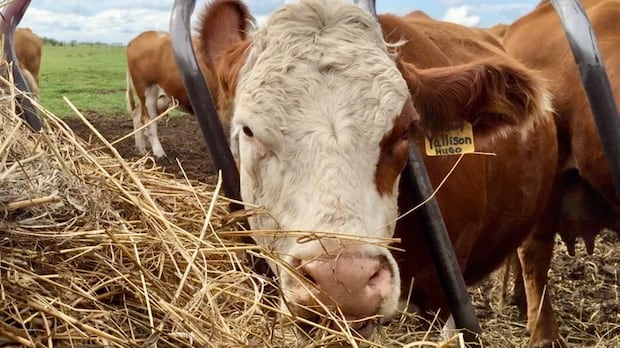
If there is a small bit of positive news for those who love to grill a steak in the summer or enjoy a roast dinner during the chilly winter months, beef prices are expected to climb further in 2026 — but not by as much as in recent years.
“The bad news is it won’t be going down,” said Mike von Massow, a food economist at the University of Guelph in Guelph, Ont.
Beef prices are at record highs after climbing 16 per cent over the last year and up 35 per cent in October compared with the five-year average. The retail price of beef is expected to creep up again next year.
The reasons behind the hefty price tags are as simple as supply and demand, with the supply of cows historically low and demand incredibly high. Yet the situation is much more complex, with ranchers facing difficult decisions on the farm and a commodity impacted by several factors, such as international trade and severe weather events.
In general, meat prices rose by the highest rate of any food category in 2025, driven by the soaring cost of beef, according to the recent national food price report by Dalhousie University in Halifax.
There are many considerations as experts weigh the question of when shoppers may finally see relief at the meat counter.
For the love of beef
Whether it’s burgers on the barbecue or stew on a chilly winter evening, there are certain foods that become traditions and part of the food culture. Those habits that can hold social significance can help explain why demand is still high for beef, regardless of the sticker shock at restaurants and grocers.
“We like beef, and beef is the favourite protein of Canadians,” von Massow said. “Canadians were very much creatures of habit. So if something was in our basket at the grocery store last week, it’s going to be in our basket at the grocery store this week.”
Still, one noticeable trend is that some shoppers are avoiding the higher-priced items for secondary cuts, such as choosing a blade steak instead of a roast. “Rather than leave beef, we’re seeing people trade down for beef,” he said.
The robust demand for beef can also be attributed to people wanting more protein in their diet.
“Beef demand has been phenomenal,” said Kevin Grier, a livestock market analyst based in Guelph. “If you want to know who to blame for high beef prices, look in the mirror,” he said.
So far, record prices don’t seem to be scaring away many shoppers. But that demand is only one reason why prices continue to climb.
Too few cows
For many decades, the number of cattle in Canada has been on the decline, and severe drought in parts of Western Canada in recent years caused the herd size to decrease further. Drought conditions drove up the price of feed at the same time as other expenses were on the rise, such as fertilizer, labour and energy prices.
The herd size is at its lowest level in Canada since the 1980s. In the United States, it’s the smallest since the 1960s.
“It’s been really dry, and it’s been even drier in the United States, and that dramatically increases costs,” said Ellen Goddard, an agricultural economist and professor emerita at the University of Alberta in Edmonton.
“The cycle for beef is very, very long. I guess we should be glad we don’t eat elephants because the cycle would be even longer,” she said.
WATCH | How much more will groceries cost in Canada in 2026?:
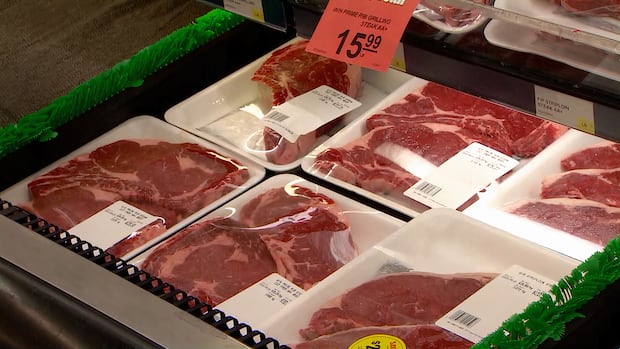
A trip to the grocery store could cost you more next year, according to a report from Dalhousie University.
Difficult choices for ranchers
Ranchers are facing a difficult decision on whether to expand their operations.
Cattle prices are at historic highs after jumping by more than 20 per cent in each of the last two years, according to Canfax, a Calgary non-profit organization that researches Canadian beef statistics.
Farmers can choose to sell their cows at really high prices, but they can also decide to keep them for a few more years to have calves. Holding onto their cows could result in retail prices temporarily climbing further.
“If we want to have a rebuild of the herd, we actually need to have short-term pain, which is more heifer retention for producers, which actually reduces supplies of beef to the market in order to get longer-term increase in supply,” said Brenna Grant, executive director of Canfax, which is a division of the Canadian Cattle Association.

For ranchers, growing their herd may also be risky considering the prevalence of drought.
“We were buying feed at $250 to $300 per bale. That’s never been heard of before,” Alberta rancher Brenda Rosadiuk said, describing how prices spiked in recent years because of parched pasture land and fields.
A bale of hay typically sells for between $100 and $150, she said.
Ranchers have to weigh many considerations, including their financial situation, age and succession planning.
By 2033, 60 per cent of farmers will be over age 65, representing one of the largest leadership transitions in the country’s history, according to RBC Economics.
Succession planning is a particular challenge in agriculture because of the rising cost of farmland, of the volatility of income from year to year and the rural lifestyle can be unappealing to younger generations.
“With the high cattle prices, some producers are saying, ‘Hey, this is a good signal for us to retire or move on to something else,’” said Rosadiuk, who ranches near Evansburg, about 100 kilometres west of Edmonton.
“Others are saying, ‘Oh, I’ve got some renewed optimism here, and I’m going to try and rebuild my herd.'”

Outside factors affect prices
Prices in Canada are impacted by many factors outside of the country, especially considering there is an open border for beef with the U.S.
In 2025, the Trump administration has introduced, changed and dropped tariffs on imports of beef from several countries, including Argentina, Brazil and Australia.
Tyson Foods, the largest U.S. meatpacker, announced plans last month to close a Nebraska beef plant and reduce operations at a Texas facility. Meanwhile, U.S. cattle producers are facing the threat of disease known as New World screwworm, a devastating pest, entering from Mexico.
All of these factors can have varying effects on demand for Canadian beef.
There are also imports of beef into Canada from countries such as Mexico and Australia, while Canadian beef can be exported to several countries around the world.
“Prices in Canada and the United States are so strong that it’s a magnet beacon [for imports],” Grier, the livestock analyst, said.
At the same time, some types of Canadian beef are exported because consumers in other countries are willing to pay higher prices for particular cuts, which are not in as high demand in Canada, he said.
That’s why it’s common to see some Canadian beef being shipped to countries like South Korea, while some Australian beef can show up on store shelves in Canada.
The steaks are high
Despite all of the variables in the industry, the general consensus by experts is that beef prices will remain high until at least 2027, when the supply begins to noticeably improve.
Still, the improvement in retail prices may only be “modest,” Grier said.
Rebuilding that herd takes time because of how long it takes cattle to reproduce, he said, especially compared to other farm animals like chickens.
“The cattle industry is like an ocean liner. It takes a long time to turn,” he said.
As for demand, people’s appetite for the red meat shows no signs of abating.
“We are still stepping up to the meat case. We’re still going to restaurants, whether it’s hamburger or whether it’s a striploin,” Grier said. “We’re still buying it.”
