


Listen to this article
Estimated 5 minutes
The audio version of this article is generated by text-to-speech, a technology based on artificial intelligence.
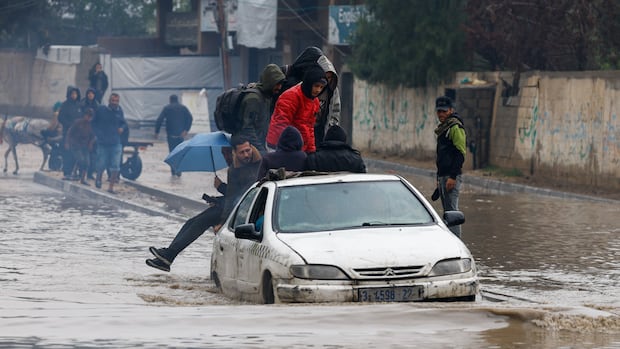
Torrential rain swept across the Gaza Strip on Thursday, flooding hundreds of tents sheltering families displaced by two years of war and leading to the death of a baby girl due to exposure, local health officials said.
Medics said eight-month-old Rahaf Abu Jazar died of exposure to cold after water inundated her family’s tent in Khan Younis, in the south of the enclave.
Weeping and holding Rahaf in her hands, her mother, Hejar Abu Jazar, said she had fed the girl before they went to sleep.
“When we woke up, we found the rain over her and the wind on her, and the girl died of cold suddenly,” she told Reuters.
“There was nothing wrong with her. Oh, the fire in my heart, the fire in my heart, oh my life,” she said in tears.
At a tent encampment in Khan Younis, some men used shovels to remove water and dirt blocking access to shelters, while others prepared sandbags to protect tents against heavy winds and rain.
“Look at this. How am I supposed to let the children sleep? Tell me how?” said Umm Mohammed Abd Elaal as she checked on her tent, toppled by the winds.
“There’s nothing [we can do]. The bedding gets soaked with water, and we need two or three days to dry it before we can sleep on it again. These tents don’t protect from rain or strong weather at all,” said her neighbour, Ahmed Salem.
Lack of equipment to prevent flooding
Municipal and civil defence officials said they were unable to cope with the storm because of fuel shortages and damage to equipment. They said Israel has destroyed hundreds of vehicles, including bulldozers and others used to pump water, during the war, which has displaced most of the population of more than two million people and left much of Gaza in ruins.
The civil defence service said most of the tent encampments across the enclave were flooded, and it received more than 2,500 calls for help. Some of the belongings of displaced people were seen floating on top of pools of rainwater that filled the alleys of the tent encampments.
A UN report said 761 displacement sites hosting about 850,000 people are at high risk of flooding and thousands of people had moved in anticipation of heavy rain.

UN and Palestinian officials said at least 300,000 new tents are urgently needed for the roughly 1.5 million people still displaced. Most existing shelters are worn out or made of thin plastic and cloth sheeting.
Gazans have resorted to ripping out iron rods from the debris of bombed houses and using them to prop up tents or to sell for a few dollars.
A ceasefire has broadly held since October, but the war destroyed much of Gaza’s infrastructure, leaving grim living conditions.
Aid shortage
Hamas-led authorities say Israel is not allowing in as much aid as promised under the truce. Aid agencies say Israel is blocking essential items. Israel says it is meeting its obligations and accuses agencies of inefficiency and failing to prevent theft by Hamas, which the group denies.
“We hold the Israeli occupation fully responsible for exposing displaced families to climate hazards as it continues closing crossings and preventing the entry of relief items and shelter materials,” said Ismail Al-Thawabta, head of the Hamas-run Gaza government media office.
The UN Palestinian refugee agency UNRWA said flooded streets and soaked tents are worsening already dire conditions.
“Cold, overcrowded and unsanitary environments heighten the risk of illness and infection,” it said on X.
“This suffering could be prevented by unhindered humanitarian aid, including medical support and proper shelter,” it added.

Humanitarian groups are warning that the amount of aid getting into Gaza is nowhere near what was promised under the terms of the ceasefire deal with Israel, and rains have left many with damaged shelters or no place to live as the weather cools.
In Gaza City, three houses collapsed as a result of the rainstorm in areas that had been devastated by Israeli bombardment, the civil emergency service said.
The Oct. 10 ceasefire has enabled hundreds of thousands of Palestinians to return to Gaza City. Israel has pulled troops back from city positions, and aid flows have increased.
But violence has not completely halted. Palestinian health authorities say Israeli forces have killed 383 people in strikes in Gaza since the truce. Israel says three of its soldiers have been killed since the ceasefire began, and it has attacked scores of fighters.
On Thursday, medics said at least one Palestinian woman was killed, and some other people were wounded in Israeli tank shelling in Jabalia in the northern Gaza Strip. The Israeli military didn’t offer immediate comment. Medics had earlier said two women were killed in the Jabalia incident.
