


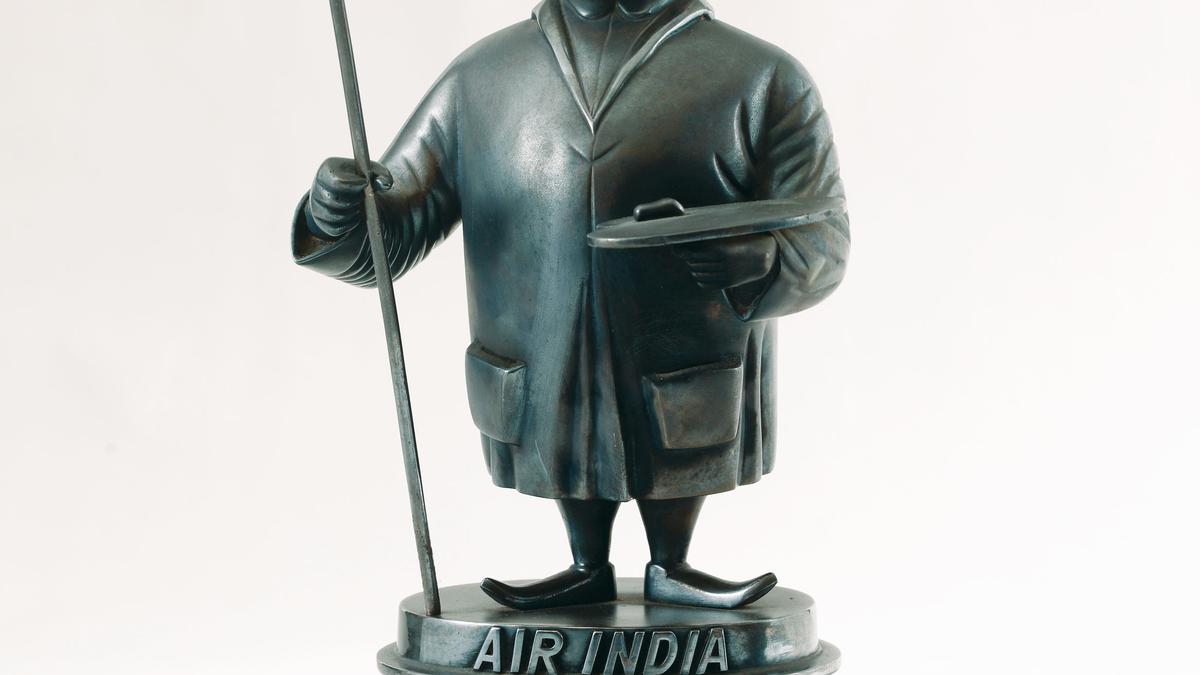
Air India recently displayed a series of art works, meticulously collected over 80 years, at its booking offices, lounges, and pavilions across the globe. The collection gives travellers a glimpse into India’s rich artistic heritage.
Air India pavilions across the world dazzled with displays of gold zari embroidered and woven textiles, gilded Tanjore paintings, polychrome wooden temple sculptures, and replicas of classical South Indian bronze figurines — dolls with musical instruments such as the sitar, veena and tabla. .There are traditional phadand pichwai paintings from Rajasthan, kalamkaris from Andhra Pradesh, Tanjore glass paintings and an exquisite array of textiles and jewellery as well as decorative art. These form a collection of 7,000 paintings and artworks by Indian artists.
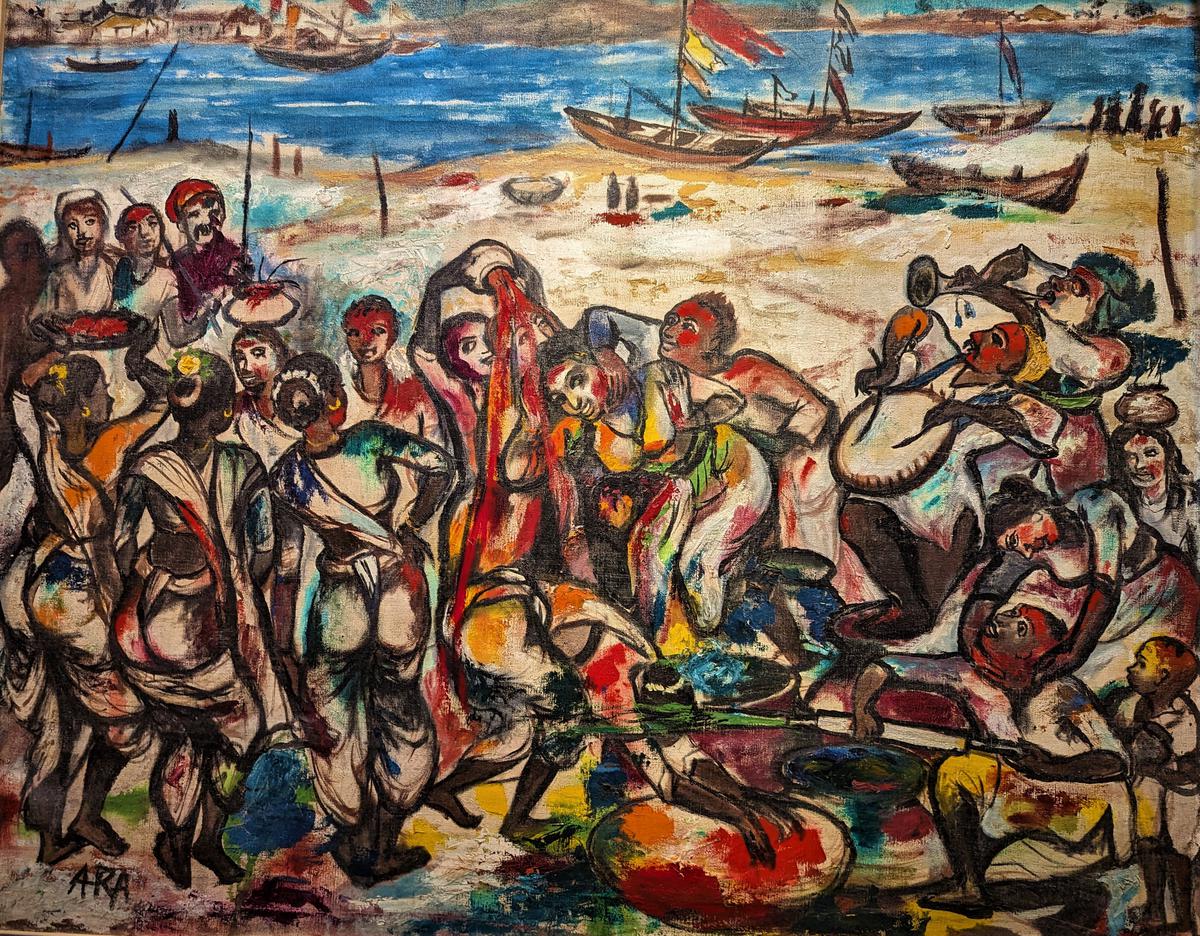
Oil on canvas ‘Holi on seaface’ from 1960 by artist K H Ara.
| Photo Credit:
Purnima Sah
Earlier this year, the Ministry of Civil Aviation officially decided to hand over these artworks to the Ministry of Culture and house these paintings at the National Gallery of Modern Art (NGMA), Mumbai.
“In 2017 there were discussions on what to do with such a large collection; having it in a store room and taking it out for the public are two different things. This is where we came in: to preserve and examine the health of the paintings, exhibit them for the public and promote art,” says Shruti Das, Deputy Curator, NGMA. “This exhibition is just a small step towards the processes we are going to start post this exhibition. We need to collect data, document and archive these valuable paintings. Research will help understand how these art works were collected and the artists who painted these. We are yet to check the age of the rest of the paintings, the ones in the exhibition are mostly from the 1960s, 70s, and 80s,” adds Shruti.
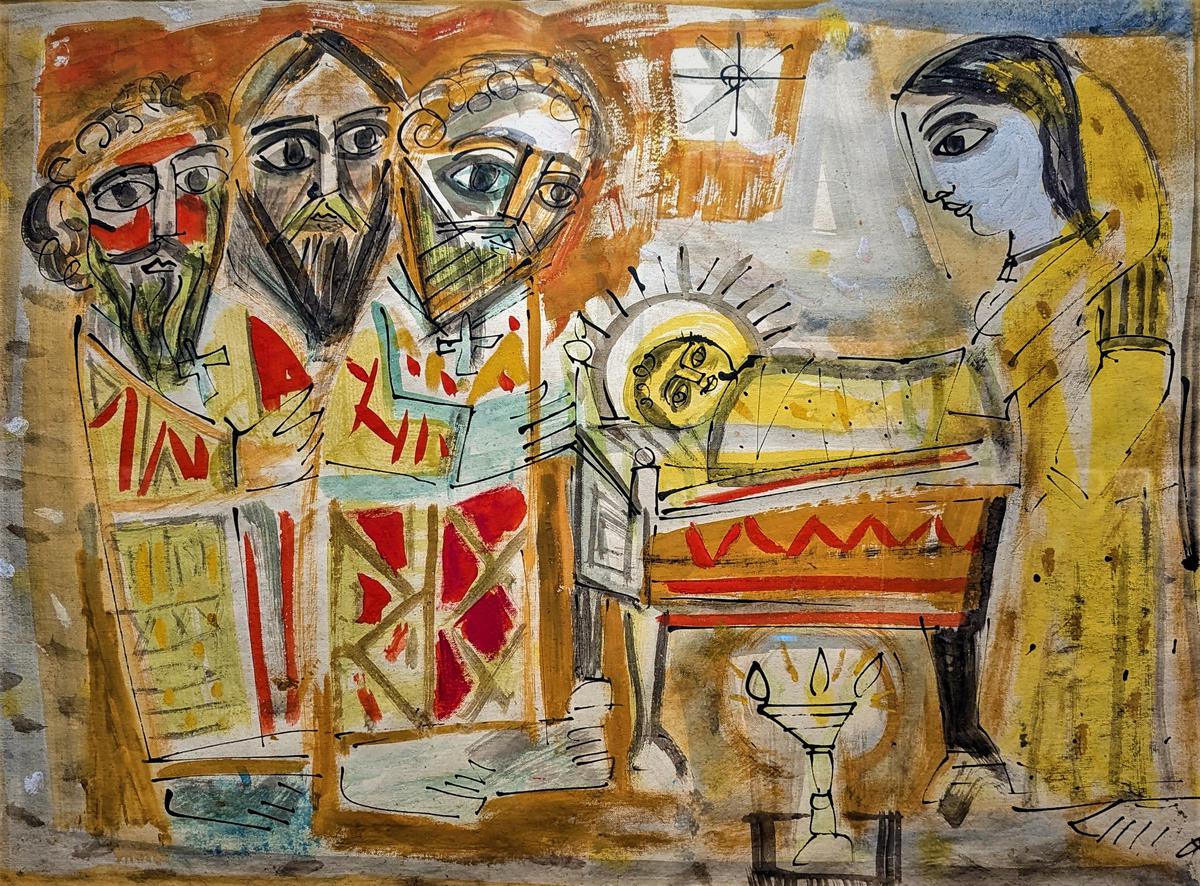
Artist Badri Narayan’s poster colour on handmade paper titled ‘Christmas’ from 1964.
| Photo Credit:
Purnima Sah
Some of these works (around 200 paintings and artworks) are now being displayed in a thematic exhibition titled Maharaja’s Treasure: Select Works of Art from the Famed Air India Collection, at NGMA, Mumbai.
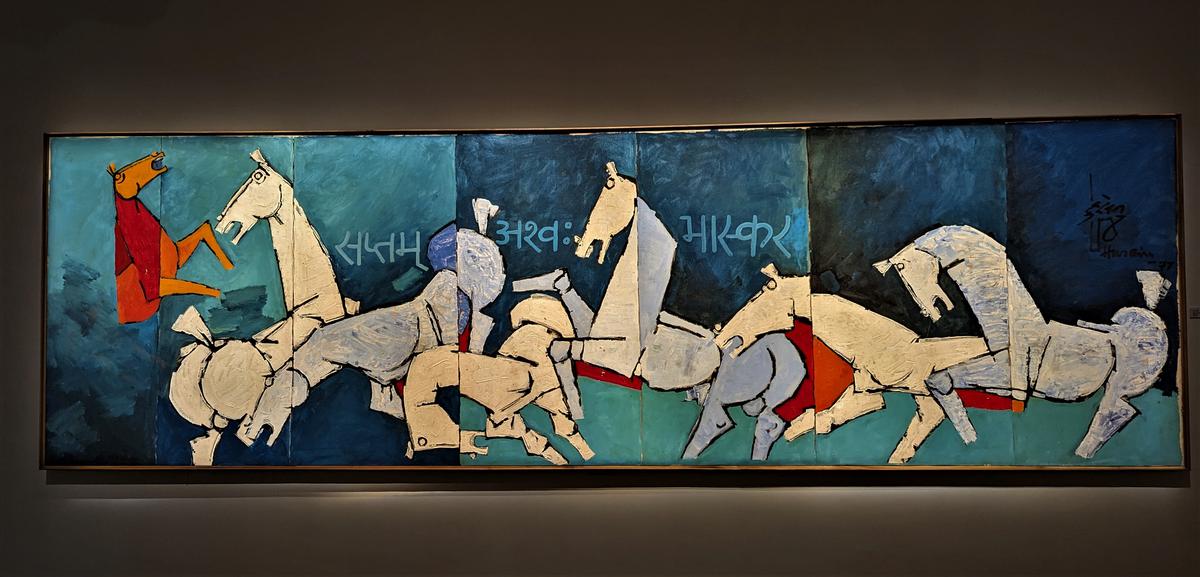
‘Horses’ painted in 1977 by M.F. Husain is acrylic on canvas.
| Photo Credit:
Purnima Sah
“This is the first celebration of the iconic collection which pioneered promoting Indian heritage across the globe. The exhibition is curated, designed, and mounted by team NGMA, showcasing select artworks of great masters, segregated into themes such as festivals, divinity, landscapes, abstract vision, women, music, and dance,” said Nazneen Banu, Director of NGMA.
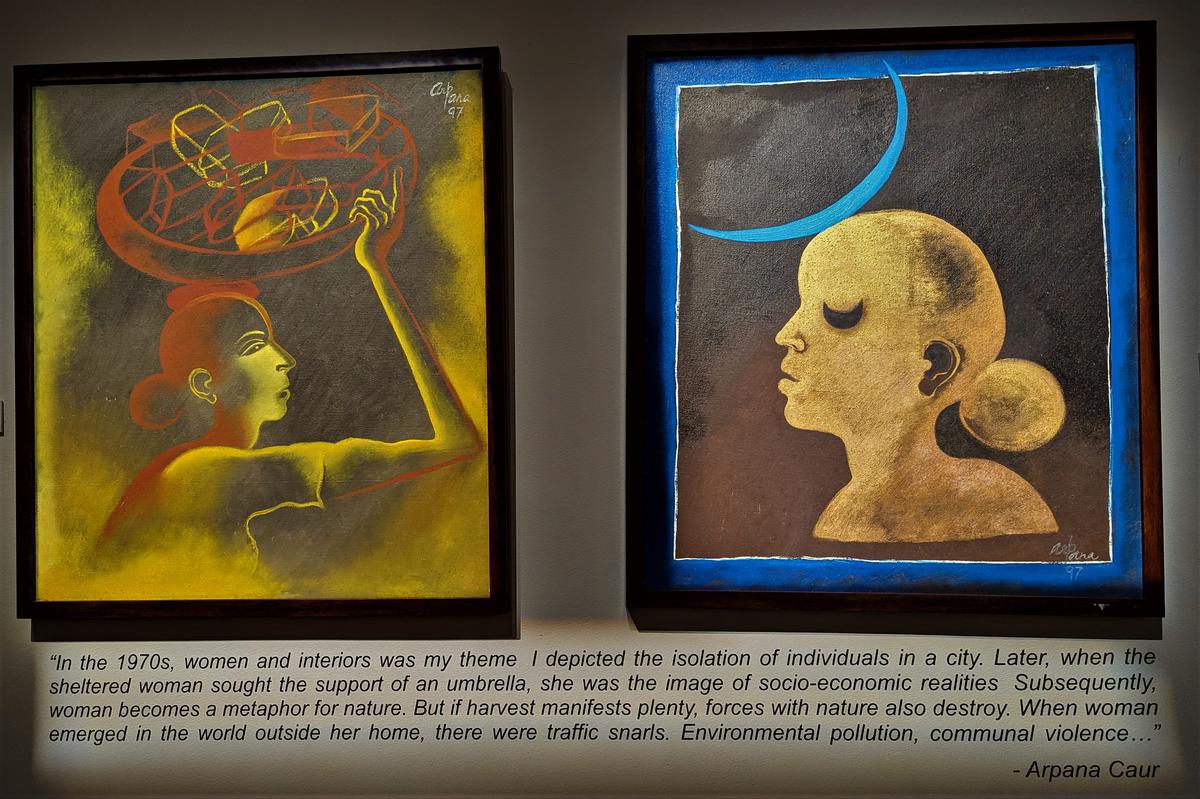
Arpana Caur’s composition, ‘Women hold up half the sky’ is depicting a woman with a blue crescent moon on her head that shows women in construction sites, where the heavy vessel on her head takes the shape of the moon.
| Photo Credit:
Purnima Sah
On entering NGMA, one is greeted with the statue of the iconic Air India Maharaja, and the celebrated works of artists such as MF Husain, KH Ara, VS Gaitonde, NS Bendre, GR Santosh, Manu Parekh, B Prabha, Anjolie Ela Menon, Piloo Pochkhanawala, Raghav Kaneria and B Vithal to name a few. An untitled canvas by Gaitonde from the 1970s, stands prominent, evoking a serene mood through the warm hues spread across the canvas. The highlight of this section is the famous ashtray designed by surrealist Salvador Dali which is in the form of a sea shell with a serpent coiled around its rim and supported by elephant heads. But when seen from the other side, the elephant heads resemble swans.
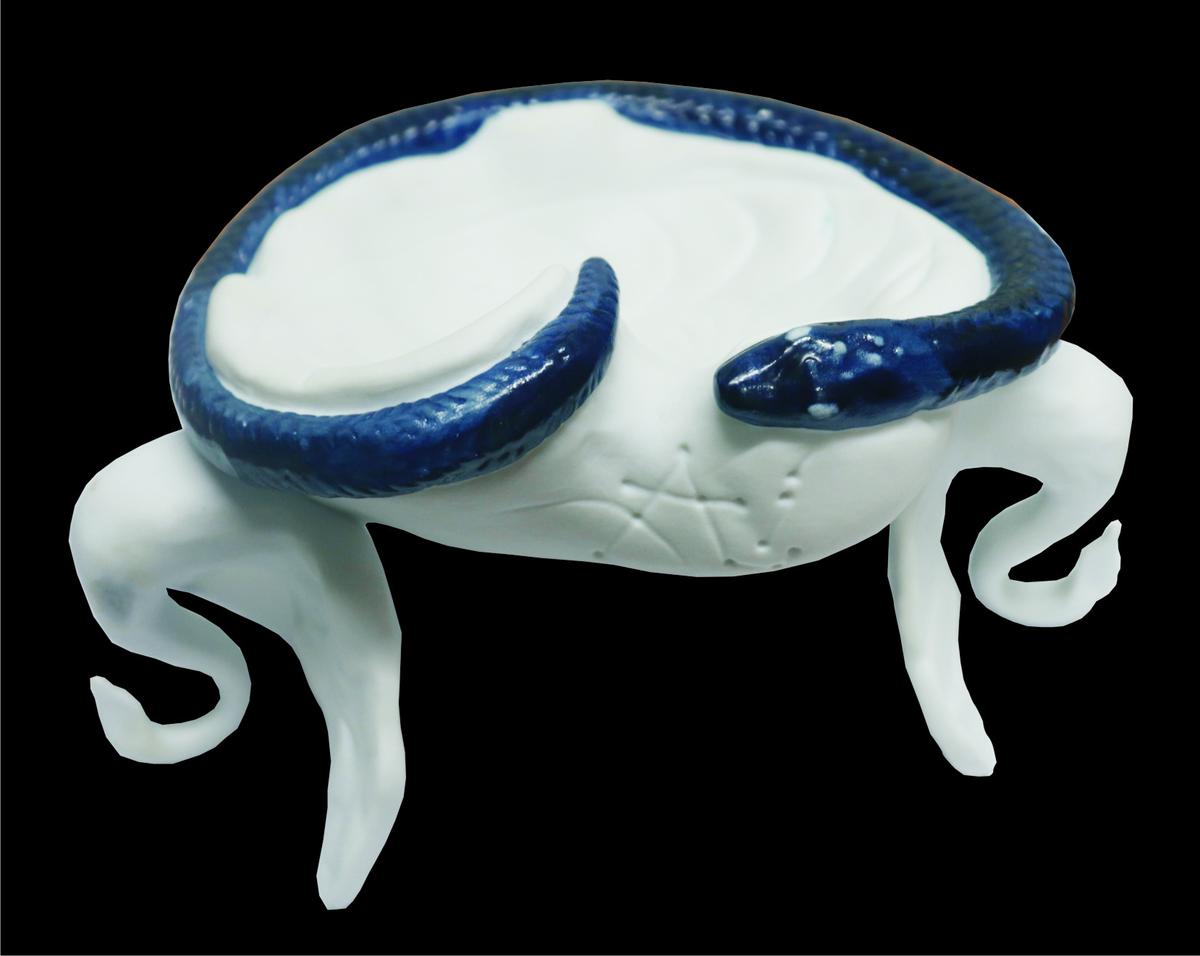
The famous ashtray designed by surrealist Salvador Dali.
| Photo Credit:
Purnima Sah
The theme is different on the next floor — there are various portrayals of women and their contributions to life and society. Arpana Caur’s canvas depicting a woman with a blue crescent moon on her head is part of a larger composition titled, Women Hold up Half the Sky. It shows women at construction sites, with heavy, moon-shaped vessels on their heads.
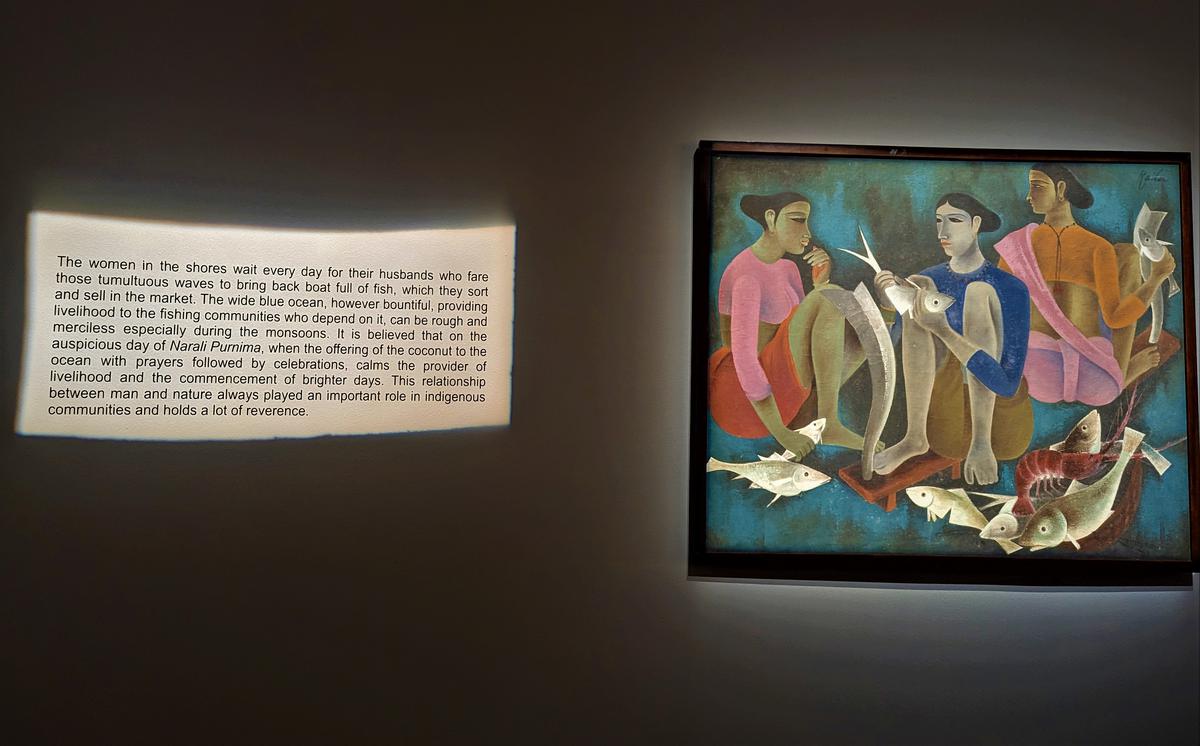
A section dedicated to the fisherwomen painted by B Prabha and A. A. Raiba.
| Photo Credit:
Purnima Sah
A section of the exhibition has actual windows mounted on the wall with different images in the frame This section highlights various landscapes laden with huts, buildings, birds, and people engaged in farming. Both the works of Anjolie Ela Menon are mounted on window frames. One titled Nawab with Pigeon, depicts a little girl’s longing to break away from the confines of age-old patriarchal traditions represented by the figure of the Nawab. The second work titled, Lady with Kite represents the little girl’s desire to experiment with the possibilities that exist outside.

Western India’s stone sculpture from the 15th century titled ‘Celestial musician’.
| Photo Credit:
Purnima Sah
Opening a new vista
Air India launched a new logo on August 10, called the vista. Inspired by its iconic jharoka pattern, the new logo includes the gold window frame, red and purple colours. This replaces the old logo of a red swan with orange spokes inside the swan.
Expressionism and abstract forms take prominence on the next floor. The vibrant canvasses of Achuthan Kudallur and Laxman Shrestha bring forth shapes that do not confer to a particular identifiable object but take one’s mind on a journey to infinite thoughts. The section proceeds to more fluid forms of SG Vasudev’s Kalpavriksha, a tree of life, flanked by Hindu deities, Ganesh and Brahma. The second half of this section is dedicated to landscapes.
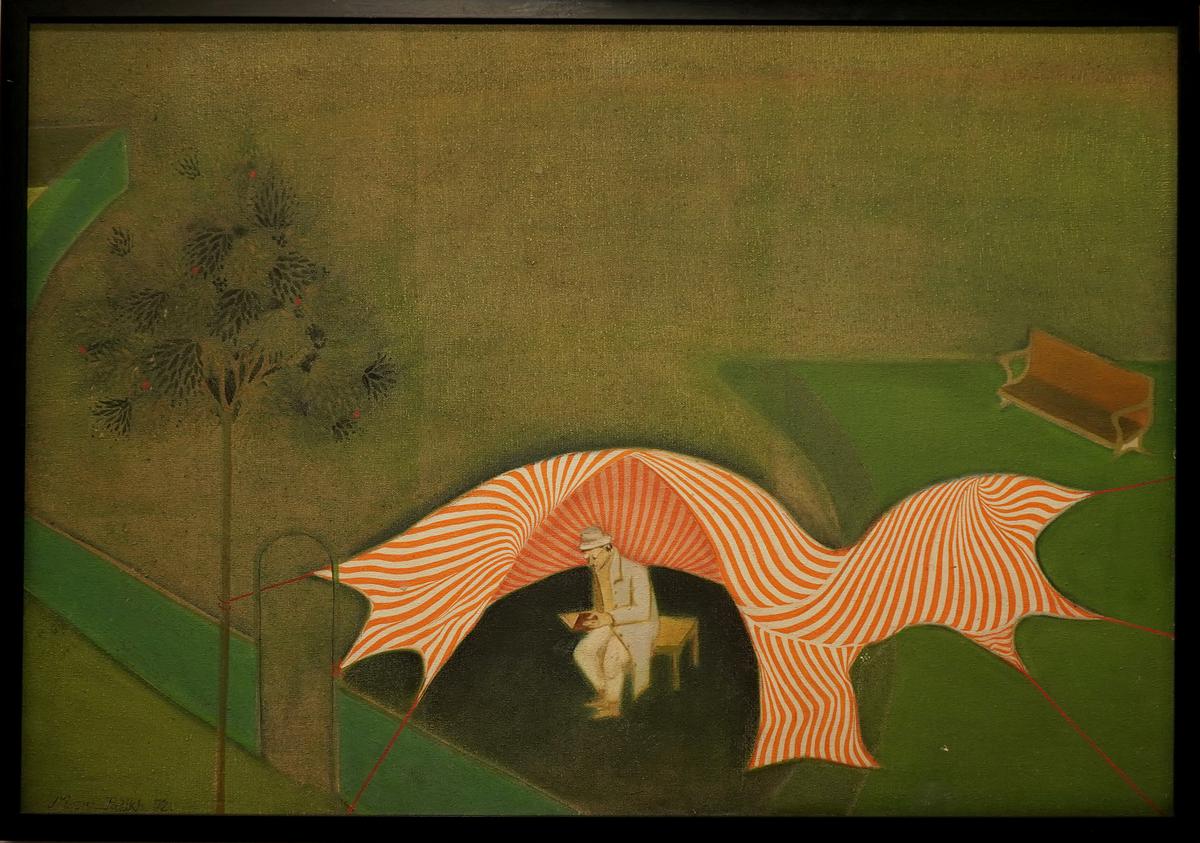
Manu Parikh’s ‘No passenger’ is oil on canvas painted in 1972.
| Photo Credit:
Purnima Sah
From its very inception, Air India had collected and promoted art from various artistic traditions of India. After Independence, when traditional patronage of the arts was dwindling , Air India played a very important role in commissioning and collecting art pieces. This zeal for collecting art and crafts of India led to the airline successfully tapping the opulence and grandeur of the erstwhile era under the maharajas, adds Nazneen.
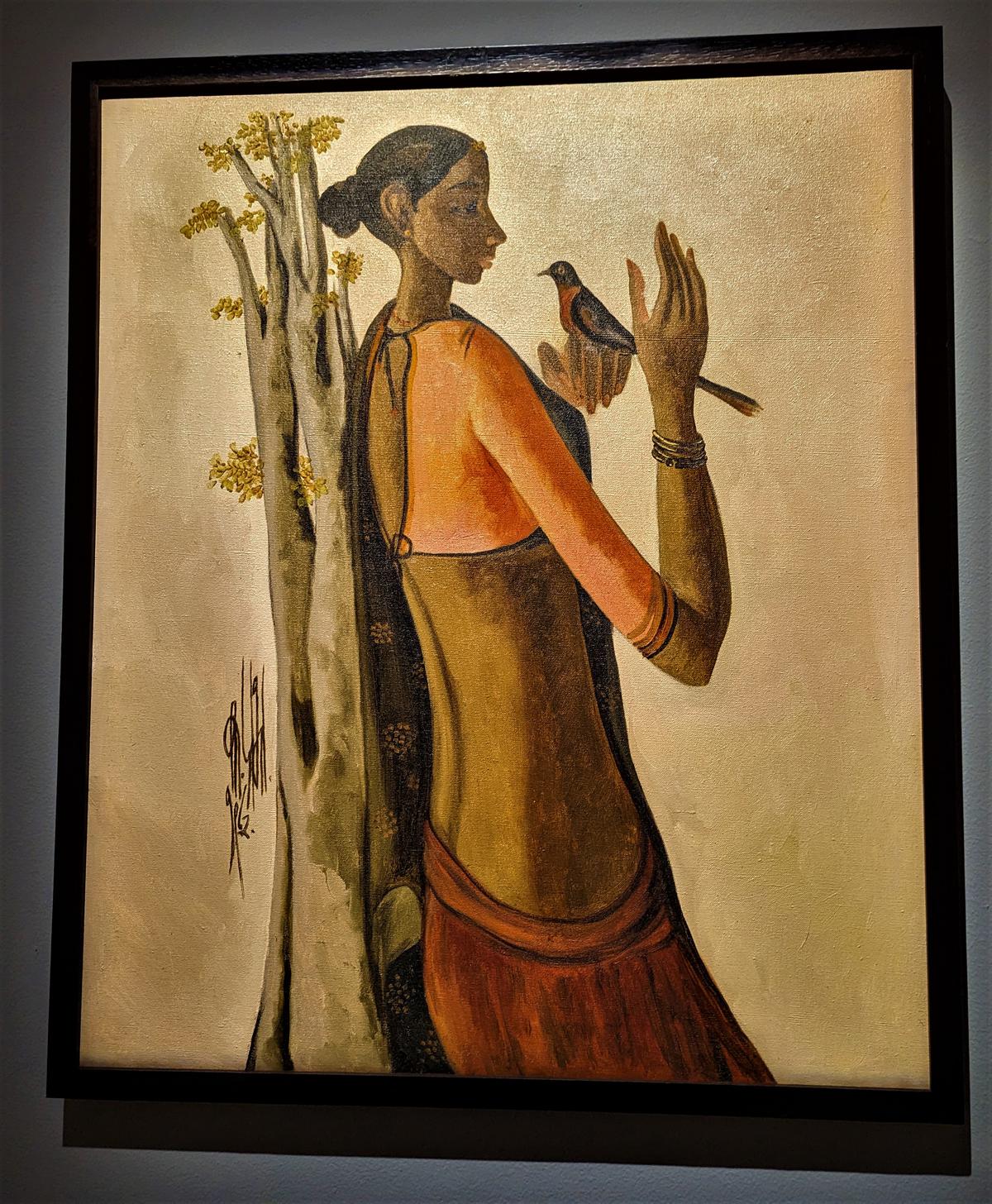
Oil on canvas titled ‘Girl with a bird’ by artist B. Prabha from 1962.
| Photo Credit:
Purnima Sah
The last floor of the exhibition concludes on a joyous note of music, dance and festivities. This section under the grand dome of the building brings to life 15th Century stone celestial musicians and a dancer, the iconic image of Nataraja, and canvasses depicting various folk and classical musicians playing different musical instruments in different milieus , some singing in troupes, some solo, some representing the musical tradition of the tribal communities in India. The celebrations around Holi and Christmas, along with the procession on the day of Muharram, also find representation in this section.
The exhibition is on view till August 20. Tuesday to Friday 11am to 6pm; Saturday and Sunday 11am to 8pm
