


About 66 million years ago, an asteroid slammed into Earth and the planet suddenly went dark.
The impact and its aftermath were catastrophic. Tsunamis inundated coastlines, earthquakes rattled the ground, acid rain poured from the skies and wildfires scorched the terrain. Roughly 75 percent of species, including all nonavian dinosaurs, went extinct.
That day is the center of “Impact: The End of the Age of the Dinosaurs,” a new exhibition at the American Museum of Natural History in New York City. “There’s no doubt — well, arguably at least — that it was the worst day of the last half billion years,” says Roger Benson, the museum’s curator of dinosaur paleobiology.
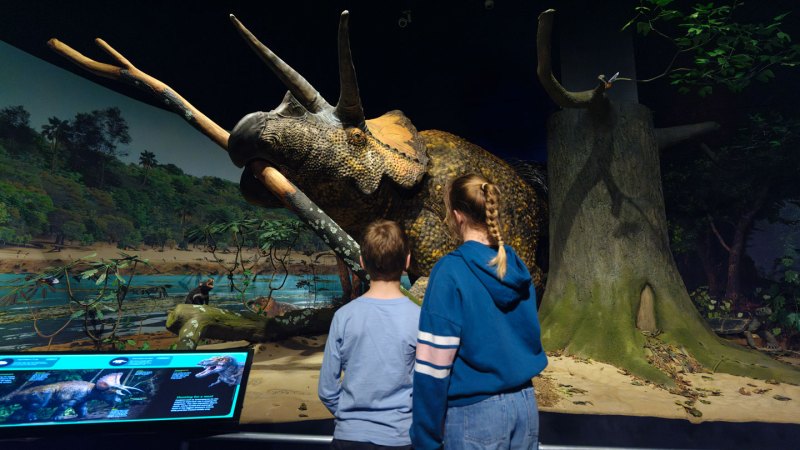
Visitors first step into life before doomsday. Inside a dimly lit hall, a life-size model of a mosasaur, a marine reptile, attacks a long-necked plesiosaur. Nearby, a Triceratops adorned with quills — a controversial hypothesis based on fossilized skin — tears down a small tree. That diorama, based on fossils from the Hell Creek formation in North Dakota, includes other animals such as turtles, birds and a Didelphodon, an extinct predatory mammal reminiscent of a Tasmanian Devil.
There’s more to do than look at dioramas. One interactive display quizzes visitors on their daily habits to find out what Cretaceous critter they are most like. Another plays sounds of certain animals, including Beelzebufo, a large predatory frog.
Then, impact.
A 6-minute film in a small theater describes, in extreme detail, the destruction wrought by a Mount Everest–sized asteroid crashing into Earth with the force of 10 billion atomic bombs. The asteroid instantly vaporized in a blast zone hotter than the surface of the sun. Its collision sent trillions of tons of rocks into the sky, blocking most sunlight for a year and a half. Many plants, and the animals who ate them, died. Here, the exhibition’s dim lighting feels deliberate — the room’s darkness makes an already grim topic feel weightier.
In the next room, the once thriving Triceratops is now a pile of bones and visitors can smell the wildfires. Spotlights draw attention to displays describing how researchers have built the case that an asteroid caused the mass extinction event, including the discovery of the Chicxulub crater off the coast of Mexico. A large globe shows the hundreds of spots where scientists have found iridium, a rare metal and a sign of extraterrestrial impact.
Missing is mention of another hypothesis: volcanism. That’s because the broad scientific consensus is that the asteroid impact was largely responsible, says Denton Ebel, a curator in the museum’s department of Earth and Planetary Sciences. “We don’t need volcanoes. The impact alone explains it,” Ebel says. “Explains the timing, explains the knife edge in history that’s recorded in the rock record.”
The asteroid’s destruction made way for new life. Across the hall, visitors learn how traits such as the ability to break open nuts helped some animals survive in the aftermath and how rainforests filled emptied landscapes. They can also find out whether their Cretaceous creature from the earlier quiz lived or died. As the world recovered, an Age of Mammals began that persists today.
There is a small chance that another massive asteroid impact could threaten Earth. But the exhibit notes that with today’s technology, we would see it coming and hopefully prevent another devastating asteroid impact. An interactive display allows visitors to practice themselves, redirecting an asteroid’s path with lasers or with a probe, akin to NASA’s DART mission.
For those who may worry about an impending apocalypse, “Impact: The End of the Age of the Dinosaurs” is a reminder that a thriving world thrown into chaos can eventually thrive again.
