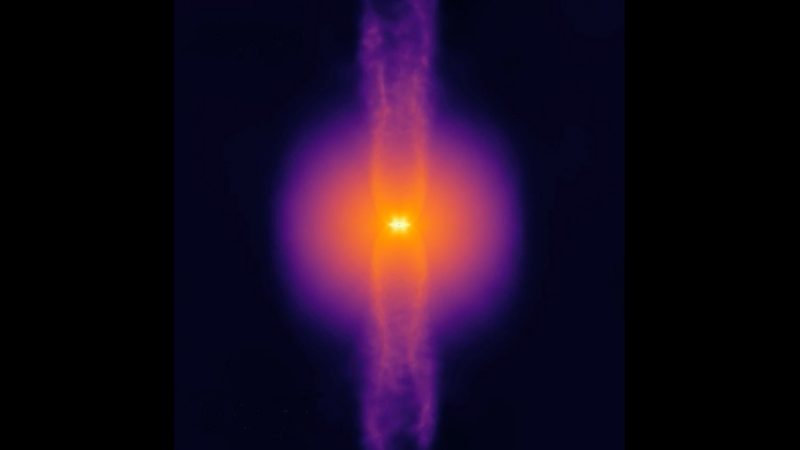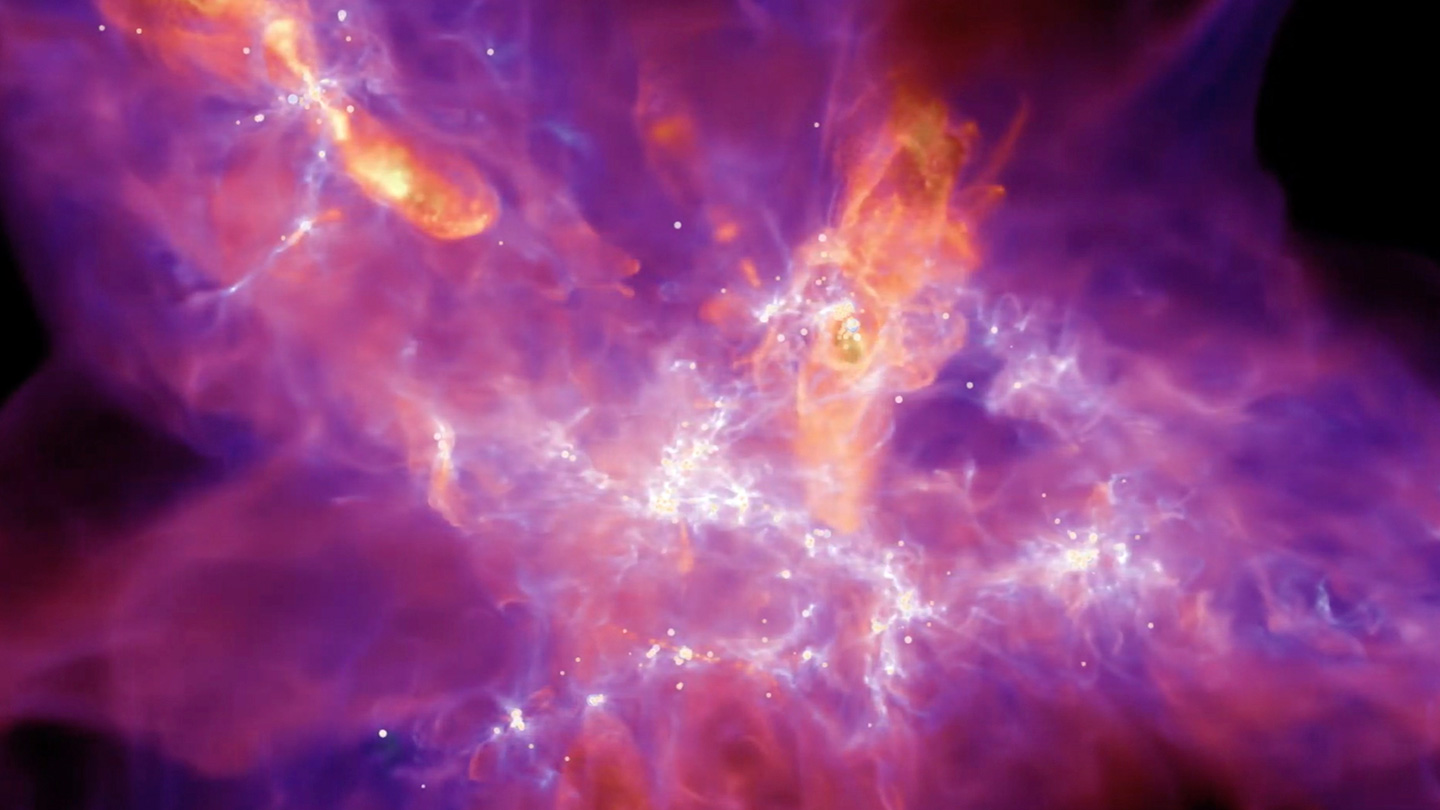
The most realistic computer simulation of star formation yet offers stunning views of what the inside of a stellar nursery might look like.
In the Star Formation in Gaseous Environments simulation, or STARFORGE, a giant virtual cloud of gas collapses into a nest of new stars. Unlike other simulations, which could render only a small clump of gas within a larger cloud, STARFORGE simulates an entire star-forming cloud. It’s also the first simulation to account for the whole medley of physical phenomena thought to influence star formation, researchers report online May 17 in Monthly Notices of the Royal Astronomical Society.
“We sort of know the basic story of star formation … but the devil is in the details,” says Mike Grudić, a theoretical astrophysicist at Northwestern University in Evanston, Ill. (SN: 4/21/20). Astronomers still don’t fully understand, for instance, why stars have different masses. “If you really want to get the full picture, then you really have to just simulate the whole thing.”
STARFORGE starts with a blob of gas that can be tens to hundreds of light-years across and up to millions of times the mass of the sun. Turbulence inside the cloud creates dense pockets that collapse to forge new stars. Those stars then launch powerful jets, give off radiation, shed stellar winds and explode in supernovas. Eventually, these phenomena blow the last vestiges of the cloud away and leave behind a hive of young stars. The whole process takes millions of years — or months of computing time, even running on supercomputers.
Using STARFORGE, Grudić and colleagues have confirmed that jets launched by new stars help regulate how much material a star amasses. In simulations without jets, typical stars were about 10 times the mass of the sun — way bigger than the actual average star. “As soon as you add this jet feedback to your simulation,” Grudić says, “stellar masses start coming out more or less right on the dot for what they’re observed to be.”