


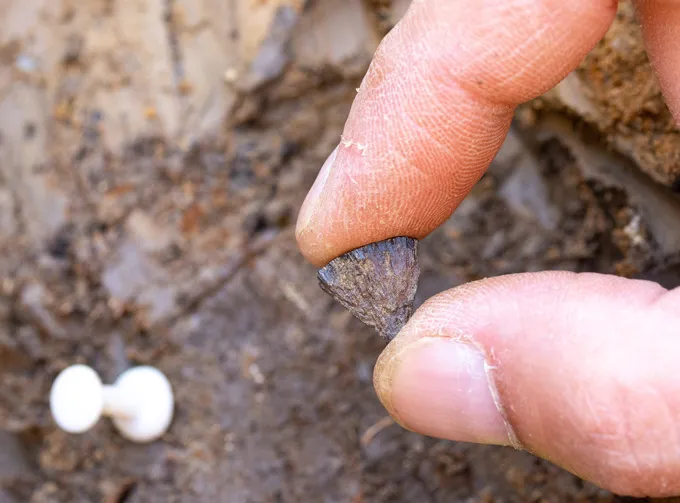
Four hundred thousand years ago, near a water hole on grasslands bordering a forest in what is now southern England, a group of Neandertals struck chunks of iron pyrite against flint to create sparks, lighting campfires on multiple occasions. A new analysis of those remnants — including fire-striking tools and geochemical traces of the burns — reveals the oldest clear evidence of archaic humans intentionally making fire.
“You get a tingle down your spine,” says archaeologist Nick Ashton of the British Museum in London. “This is a major change in how human societies begin to operate.”
Previously the earliest known use of iron pyrite and flint to strike fire came from Neandertals in northern France about 50,000 years ago. The discovery in Barnham, England — reported December 10 in Nature — pushes this practice back by roughly 350,000 years.
“For the first time, we actually have excellent evidence at a site of that age of fire making and not only fire using,” says Marie Soressi, an archaeologist at Leiden University in the Netherlands who was not involved in the study. “Being able to have it at will is really a game changer.”
The ability to make fire transformed human evolution. The light and warmth of a campfire scared away predators and provided a place for early humans to socialize at night. Cooking food removed toxins, extended shelf life and reduced the calories needed to digest — a change that may have facilitated further brain development.
Humans and their relatives have used fire for probably more than a million years. Sites in Kenya and South Africa show signs of fire use by Homo erectus. A site in northern Israel preserves remnants of hearths from about 780,000 years ago, but no fire-striking tools have been found, leaving open whether those fires were gathered or made.
The Barnham site has long been known for its Paleolithic stone tools. In 2014, Ashton and colleagues discovered heat-shattered flint but couldn’t rule out a natural fire. Three years later, the team found bits of iron pyrite, which can be used to strike sparks, though it was unclear whether it had been deposited naturally.
In 2021, they had “the first proper breakthrough,” Ashton says. He spotted reddened clay in a long-overlooked area. “I thought, ‘I’m sure that looks like heated or burnt sediment.’”
Geochemical analysis suggested the sediment had been heated multiple times to more than 700 degrees Celsius. A geologic survey showed that iron pyrite is extraordinarily rare locally, suggesting it was transported to the area.
“I’ve been generally skeptical of fire-making claims,” says Dennis Sandgathe, a Paleolithic archaeologist at Simon Fraser University in Burnaby, Canada. But “finding a couple of chunks of iron pyrite in what appears to be pretty close association with fire residues — that’s a pretty compelling argument that they’re making fire.”
The ancient campfires date to an interglacial period of warmer temperatures. Few human remains have been preserved at Barnham, but based on the age of the deposits and the tools found, researchers believe the fire makers were early Neandertals or a closely related group.
Many questions remain about early fire use, including whether fire-making knowledge spread rapidly among populations or arose repeatedly in isolated incidents. “It’s highly possible that it was invented and then lost because the density of the population at that time was extremely low,” Soressi says.
Ashton, however, believes that future discoveries may reveal that fire making was more common than previously thought. “I think we always underestimate the ability of our early ancestors.”
