


Listen to this article
Estimated 5 minutes
The audio version of this article is generated by text-to-speech, a technology based on artificial intelligence.
Ukrainian President Volodymyr Zelenskyy met with Pope Leo XIV near Rome on Tuesday as he continued to rally European support for Ukraine while resisting U.S. pressure for a painful compromise with Russia.
Answering reporters’ questions in a WhatsApp chat, Zelenskyy reaffimed his firm refusal to cede any territory, saying that “we clearly don’t want to give up anything,” even as “the Americans are looking for a compromise today, I will be honest.”
“Undoubtedly, Russia insists for us to give up territories,” he said in the message late Monday. “According to the law we don’t have such right. According to Ukraine’s law, our constitution, international law, and to be frank, we don’t have a moral right either.”
The Ukrainian president met early Tuesday with Leo at Castel Gandolfo, a papal residence outside Rome, and is to have talks with Prime Minister Giorgia Meloni later.
Zelenskyy said his country “deeply appreciates” the humanitarian support of Pope Leo.
“I informed the Pope about diplomatic efforts with the United States to achieve peace. We discussed further actions and the Vatican’s mediation aimed at returning our children abducted by Russia,” he wrote on X.
The Holy See has tried to remain neutral in the war while offering solidarity and assistance to what it calls the “martyred” people of Ukraine. Leo has met now three times with Zelenskyy and has spoken by telephone at least once with Russian President Vladimir Putin.

Ukrainian officials say 19,000 children have been forcibly transferred to Russia since the war began, including many with complicated health issues.
The U.S.-born pope has called for a ceasefire and urged Russia in particular to make gestures to promote peace.
The Pope “reiterated the need for the continuation of dialogue and expressed his urgent desire that the current diplomatic initiatives bring about a just and lasting peace,” the Vatican said in a statement.
“In addition, the questions of prisoners of war and the need to assure the return of Ukrainian children to their families were also discussed,” said the Vatican, which has mediated between Kyiv and Moscow on the children issue.
Several points struck from original plan: Zelenskyy
U.S. and Ukrainian negotiators completed three days of talks on Saturday aimed at trying to narrow differences on the U.S. administration’s peace proposal. An early version from the U.S. caused confusion and riled European allies who felt shut out from the process.
Zelenskyy said Monday that Trump “certainly wants to end the war…. Surely, he has his own vision. We live here, from within we see details and nuances; we perceive everything much deeper, because this is our motherland.”
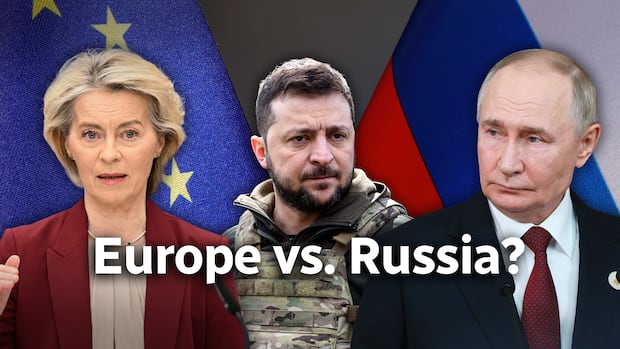
Investments are being made across Europe to shore up its defence capabilities in the face of increased Russian aggression and an uncertain defence alliance with the United States. Andrew Chang explores the steps Europe is taking to deter a possible Russian attack.
Images provided by The Canadian Press, Reuters and Getty Images
He said the current U.S. peace plan differs from earlier versions in that it now has 20 points, down from 28, after he said some “obvious anti-Ukrainian points were removed.”
On Monday, Zelenskyy met with the leaders of Britain, France and Germany, as well as NATO and European Union officials.
European leaders are working to ensure that any ceasefire is backed by solid security guarantees both from Europe and the U.S. to deter Russia from attacking again. Trump has not given explicit guarantees in public.
A major sticking point in the U.S. plan is the suggestion that Kyiv must cede control of the Donbas region of eastern Ukraine to Russia, which illegally occupies most but not all of the territory. Ukraine and its European allies have firmly resisted the idea of handing over land.
Zelenskyy and his European allies have repeatedly accused Putin of slow-walking the talks to press ahead with the invasion as his forces are making slow but steady gains while waves of missiles and drones pummel Ukrainian infrastructure.
The United Nations Security Council is scheduled Tuesday morning to meet on the humanitarian situation in Ukraine, in a meeting chaired by Slovenia.
In overnight fighting, Ukraine’s Air Force said Russia fired 110 drones of various types across the country last night. They said air defences neutralized 84 drones, but 24 more struck their targets.
Several regions of Ukraine faced emergency blackouts Tuesday due to Russia’s prior attacks on energy infrastructure, according to Ukraine’s national energy operator, Ukrenergo.
Ukraine, in its turn, continued its drone attacks on Russia.
Russian air defences destroyed 121 Ukrainian drones overnight above various Russian regions and occupied Crimea, Russia’s Ministry of Defence said Tuesday. In Chuvashia, a region about 900 kilometres northeast of the border with Ukraine, the attack damaged residential buildings and injured nine people, local governor Oleg Nikolayev said in an online statement.
