


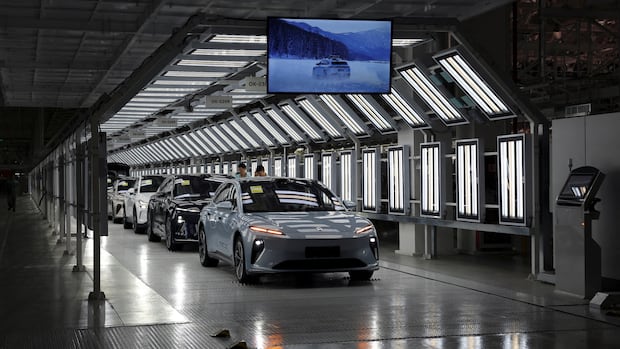
China’s massive lead in clean technologies has shifted the global climate fight from one of big pledges and international diplomacy toward a technological revolution in cheaper energy, analysts say.
The accelerated adoption of clean technologies — particularly solar and wind power, as well as electric vehicles — has challenged long-held assumptions about how central fossil fuels are to modern industrial development, as well as which countries would lead the world in the climate fight.
The contrast between countries embracing clean technologies and countries still dependent on producing and burning fossil fuels is also becoming wider. Countries like the U.S., now the world’s largest oil producer, could be left behind in the race for the energy sources of the future.
“We’re having a kind of a politics whereby petrostates are resisting change and new emerging electrostates like China are pushing it forward,” said Sam Butler-Sloss, research manager at the global energy think-tank Ember.
“The energy transition has reached a maturity whereby it now threatens various vested interests.”
Ember’s analysis of China’s energy transition shows the country has reached a critical point where it can supply the whole world’s needs for clean energy, not just its own. The country’s solar manufacturing capacity is 65 per cent higher than what’s required — globally — in the International Energy Agency’s net-zero roadmap.
That means that China has the capacity to manufacture and supply enough solar panels for the world to reach net-zero emissions by 2050.
“These already cheap electro-tech [products] are going to get cheaper, and that only strengthens the already strong consumer case for electric vehicles and for solar and batteries,” Butler-Sloss said.
Who is adopting clean Chinese tech?
Two-thirds of emerging countries have now overtaken the U.S. in terms of the proportion of solar energy in their total power generation, according to Ember. That includes places like South Africa, Vietnam, Pakistan, Chile and many more.
The U.S. under President Donald Trump is doubling down on fossil energy — heavily promoting U.S. oil and gas exports, clearing the way for more production and removing incentives for solar or wind and electric vehicles.
Butler-Sloss said the old assumption that rich countries would adopt clean energies first and then support developing countries to do the same “is being flipped upside down.”
The Global South is much further ahead than rich Western nations in the energy transition, primarily because they need cheap energy and are much better positioned for it.
About 80 per cent of the world’s population lives in the so-called Sun Belt, with ample access to solar energy.
“The geography of new energy is in emerging markets’ favour,” Butler-Sloss said.
It’s been more than 10 years since the Paris Agreement was signed, as nearly 200 countries pledged to place limits on rising global temperatures. The target of keeping temperature rise below 1.5 C has failed, but CBC’s Susan Ormiston takes a look at what has been achieved and where we can go from here.
The enthusiasm for solar and wind power suggests developing countries are leapfrogging the kind of oil and gas-fuelled development that helped industrialize Western nations.
Li Shuo, senior fellow at the Asia Society Policy Institute in Washington D.C., and a leading researcher of Chinese climate policy, says developing nations are driven by economic self-interest.
“We’re increasingly seeing a Global North-Global South divide in terms of their respective responses to Chinese inputs in their own energy transition,” Li said. Developing countries are simply buying the cheapest and most advanced solar panels or electric vehicles, which come from China, while higher-income countries are putting tariffs and other trade barriers on those same products.
Li says this sets up Western nations to fail in terms of making energy and products more affordable, and also cutting their emissions.
“If you don’t balance your reaction to Chinese inputs in a nuanced and smart way, then you might end up not fulfilling any objectives that you want to achieve,” he said.
What should countries like Canada do?
Because of China’s role in clean technology — accounting for most of the world’s manufacturing of electric vehicles, for instance, or controlling most of the rare earth minerals required in batteries — Li says countries simply “can’t avoid the China question.”
“How do you position yourself vis-à-vis China? Do you welcome Chinese inputs, scrutinize Chinese inputs, allow them in with conditions or just outright reject them? I think every country needs to examine this question very carefully,” he said.
“No one, in my view, could afford an ideologically driven approach. Outward rejection I don’t think is an option as long as a country is still somewhat committed to the decarbonization agenda.”
Butler-Sloss said certain products provide far greater value to the consumer that uses them than to the industry that manufactures them. Solar panels, for example, provide 100 times more value to customers, who get cheap, clean power, than the producers, who see very low profit margins on them.

Other products like electric vehicles are more complicated. Canada has mirrored the U.S. in slapping tariffs on Chinese EVs, effectively keeping them out of the domestic market. Li says he’s watching to see if that changes as Prime Minister Mark Carney pursues warming relations with China.
What’s the future for global climate action?
“My general thesis is over the next few years … there might be a reckoning on the China question. I think more and more political conditions may emerge which will force different countries to reposition themselves on how they reacted to Chinese inputs,” Li said.
“In particular in the clean tech sector, because there’s a need to decarbonize and also because China is just so dominant in this area.”
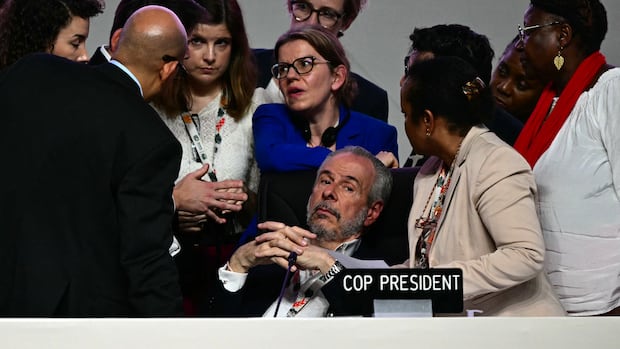
Brazil’s COP30 presidency pushed through a compromise climate deal on Saturday that would boost finances for poor nations coping with global warming but that omitted any mention of the fossil fuels driving it. The deal raised objections by Colombia, Panama and Uruguay, before COP30 president Andre Correa do Lago suspended the plenary for further consultations.
With the U.S. withdrawing from the Paris Agreement on global warming and pulling its diplomatic presence from international climate negotiations, the nature of the UN’s climate conferences is also shifting, observers say.
At this year’s COP30 in Belem, Brazil, various groups tried to fill the gap left by the U.S. absence, with no clear successor.
Li said the conference signalled a shift in the nature of global climate action itself, with the elevation of trade and economics over country pledges. Rather than being a major diplomatic force, he said China’s “contribution to the global climate agenda, at least in the near term, will primarily be manifested in the real economy” of making and exporting clean technology.
“In a way, I would argue that that is fine,” Li said. “You could argue the real economy leadership is actually more consequential than the political leadership.”
