

Immunity for Alberta attorney general necessary to ward off ‘political activism,’ attorney general says

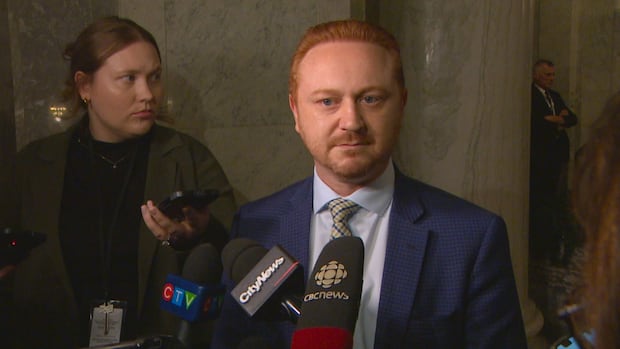
Alberta’s justice minister, who is also the attorney general, says new rules that would grant anyone who’s in his job general immunity from law society sanctions are necessary to ward off “political activism, or complaints, or other interference.”
“I think that there is a very distinctive role that the attorney general plays in this province, and it must be upheld without influence from external factors,” Mickey Amery told reporters Monday.
Last Thursday, Amery introduced Bill 14, legislation that includes multiple significant changes to the political and legal landscape in Alberta.
Among those changes are amendments to the Legal Profession Act, which governs lawyers of the Law Society of Alberta.
It would make Alberta’s attorney general immune from sanctions while carrying out the “duties and functions” of the position.
The attorney general serves as the chief legal adviser to the government and is responsible for overseeing the province’s prosecution services. For years, the same person has been justice minister and attorney general, and it’s the same case in other jurisdictions.
Amery was asked Monday if an incident involving former provincial justice minister Kaycee Madu, who was reprimanded by the law society in February, was considered in drafting the change. The regulator found Madu guilty of misconduct last year for phoning Edmonton’s police chief after receiving a traffic ticket in 2021 while he served as attorney general.
“Well, first and foremost, the amendments specifically state ‘official duties’ of the attorney general,” Amery said.
“And I think that’s an important takeaway here, because it signals that the amendments are intended to shield the attorney generals, both past and present and future, from political activism or complaints or other interference for that office.”
Madu is appealing the law society decision. It’s set to be heard in February.
In an email, a spokesperson for Amery said Bill 14 would only apply to actions as part of the attorney general’s official duties and to those that have not already been sanctioned.
They did not respond to a question requesting more information around what “political activism” Amery was addressing specifically.
Madu’s successor as minister of justice, Tyler Shandro, also faced a law society proceeding, though that came from incidents during his time as health minister. He was found not guilty of unprofessional conduct, in part because hearing panellists concluded he wasn’t acting as a lawyer during the incidents.
A third Alberta justice minister, Jonathan Denis, was also sanctioned for professional misconduct citations after he left government.

Speaking Thursday after Bill 14 was introduced, Alberta NDP deputy leader Rakhi Pancholi called the immunity provisions “one of the craziest parts” of the legislation.
“[Amery is] saying he doesn’t want to be subject to the same standards as other lawyers in his conduct and behaviour, as the top lawyer in this province,” Pancholi said.
The law society said it was reviewing “all matters to determine impact of the new bills, if any.”
In an email, Elizabeth Osler, the chief executive officer of the law society, wrote that the organization would still be able to sanction an attorney general outside of their official role.
Official business
In laying out the new immunity plan, Alberta pointed to Ontario, writing in a release that the rules were similar to what’s in place in that province.
Dalhousie University Schulich School of Law professor Andrew Martin, who has written extensively on this topic, said Alberta is stepping into somewhat uncharted waters.
Despite being on the books for decades, the Ontario immunity provision has never been applied in a reported decision to quash a proceeding against the attorney general, Martin said. But because complaints only become public if they reach a hearing, no one knows how often the provision has been invoked, he said.
For Martin, the arguments for and against such protections come down to how much trust exists in the regulator and the political system it oversees.

There’s a concern amongst some that political opponents or aggrieved citizens might file dubious complaints to cause “interference” for the sake of impairing the attorney general’s ability to carry out their important functions, Martin said.
On the flip side, the rule of law applies to everyone, including attorneys general who are licensed lawyers, he said.
Granting immunity without explaining why invites speculation, he said.
“What are they responding to? What are they concerned about? And I think without that information, it becomes very hard to evaluate: is this appropriate or not appropriate? Is this a good amendment or not a good amendment?” Martin said.
“It’s a question of: how much confidence do you have in the law society and its benchers in performing their role in the public interest?”
The law society is governed by 24 individuals known as benchers. The legislation also aims to see appeals of law society disciplinary decisions be heard in the Court of King’s Bench, rather than by the benchers.
